HIGHLIGHTS: JULY 11, 2025
• New deadline for trade deals set at Aug. 1
• Letter highlights need for chief ag negotiator
• U.S. dairy exports dip in May
• Coalition seeks to halt proposed fees on Chinese-built ships
• USDEC raises U.S. dairy profile in Guatemala
• Spending reconciliation bill raises ag promotion funding
• Defending common food names at WIPO
• Letter supports Lindberg as USDA under secretary
• USDEC meets with new FAS attachés at USAEDC meeting
• USDEC 2025 event calendar
• Market Summary: EU milk deliveries barely rise in May
• Goulburn Valley upgrades plant
• Lactalis cleared for potential purchase of Fonterra businesses
• Baladna makes plans for Syria, Egypt
• Company briefs: Juhayna, Danona, Southern Dairy, Procal
Featured
New and old reciprocal tariffs to start on August 1
On Monday, President Trump stated that his reciprocal tariffs will start on Aug. 1 and began sending letters to nations with new tariff levels, expecting the letters will encourage nations to negotiate deals with the United States before getting hit with higher tariff rates.
So far, the United States announced a framework to negotiate an agreement with the UK (see Global Dairy eBrief, 5/9/25), come to a temporary trade truce with China (see Global Dairy eBrief, 5/16/25), and reportedly settled on a trade deal with Vietnam (although neither side has officially announced details of what that pact might look like) and several other countries.
At press time, those countries receiving letters included Brazil, Canada, Indonesia, Japan, Malaysia, South Africa, South Korea, Thailand and Tunisia. The new tariff rates vary by country but are similar to the rates announced in April. They range between 25% and 50%.
Additional country-by-country information about the status of tariffs, which is evolving by the day, can be found in USDEC’s tariff tracker here. Please contact Tony Rice (trice@usdec.org) with any questions.
Letter to president highlights need for chief agricultural negotiator
A coalition of 42 U.S. agricultural associations, including USDEC and NMPF, sent a joint letter to President Trump urging him to expeditiously nominate a chief agricultural negotiator in the office of the USTR. The co-signers say they are encouraged that the administration is pursuing a historic number of trade agreements, as well as its willingness to address unfair trade practices that are distorting markets and creating supply chain vulnerabilities in the U.S. food system.
“[But] to ensure that meaningful progress is made, we seek the nomination and confirmation of a chief agricultural negotiator to prioritize agriculture issues at the negotiating table and secure wins for rural America,” the letter states.
“A strong advocate in this role helps to ensure that agricultural priorities are integrated early and consistently throughout the negotiation process and brings critical expertise in the full range of agricultural production, supply chain, and technical issues,” the letter states. It’s that kind of advocacy that will lead to agreements that “deliver real, tangible benefits for rural communities and the broader U.S. economy.”
U.S. dairy exports decline in May on reduced Chinese purchasing
Most U.S. dairy product categories performed well in May, with cheese, butterfat, milk powder and high-protein whey all posting year-over-year (YOY) gains. Cheese volume even set a record. But total YOY milk solids equivalent (MSE) exports for the month fell 2%, as ongoing tariff tensions with China dragged down shipments of low-protein whey (mostly whey permeate) and lactose, overwhelming the other gains.
May U.S. cheese exports set a record for volume in a single month, topping 50,000 MT for the first time. It was previously reported that U.S. cheese exports topped 50,000 MT for the first and only time in March 2024, but with the government release of adjusted trade numbers this month, the March 2024 total came down to 49,976 MT.
While YOY cheese shipments to Mexico declined, just about every other significant market posted gains, including Japan +24% (+1,148 MT), South Korea +20% (+1,102 MT), Central America +23% (+1,054 MT) and South America +47% (+1,020 MT). Global cheese demand remains strong, and U.S. suppliers have been enjoying a price advantage since late 2024—factors that bode well for exporting more cheese this year.
YOY U.S. nonfat dry milk/skim milk powder (NFDM/SMP) volume increased for the second time this year, rising 2% (+1,059 MT) to 61,953 MT. U.S. butterfat exports (butter and AMF) remained on record pace, as YOY volume rose 151% (+4,506 MT) in May to 7,486 MT. And WPC80+ shipments jumped 14% (+852 MT), after adjusting for misclassified shipments to China.
What ultimately dragged down total U.S. MSE volume for the month was sharply reduced buying from China. YOY low-protein whey shipments to China had the biggest impact, plummeting 70% (-15,649 MT), but exports of lactose fell 59% (-4,727 MT), NFDM/SMP slumped by 75% (-1,159 MT), WPC80+ dropped 83% (-822 MT), and cheese exports slipped 81% (-988 MT) for the month.
For more in-depth analysis of May results, read the U.S. Dairy Exporter Blog Post, “U.S. exports slip 2% in May,” and take a look at the interactive charts in the USDEC Data Hub on usdec.org.
Coalition asks USTR to halt port fees on Chinese-built ships
USDEC joined a broad coalition of more than 150 U.S. agricultural exporters, importers, farmers and agribusinesses, manufacturers, energy providers, wholesalers, transportation and logistics providers and other groups in signing a letter to USTR Jamieson Greer urging him not to impose proposed fees on Chinese-built vessels entering U.S. ports. The proposed fees stem from a Special 301 investigation on Chinese shipping dominance as part of an effort to support domestic U.S. shipbuilding.
The USTR already revised the original proposed ship fees on Chinese-linked ships coming into U.S. ports in April after significant industry outcry (see Global Dairy eBrief, 4/18/25). USDEC filed comments, signed letters and helped coordinate congressional letters expressing concerns about the measures in the original proposal, calling for reducing the fees.
The latest letter expresses appreciation for the previous changes but cautions that proposed port fees that remain in place will still cause significant damage to U.S. supply chains, directly hurting American businesses and consumers. The fees will be passed along directly to U.S. exporters and importers, undermining U.S. competitiveness and leading to higher U.S. consumer prices. The letter’s signers contend the fees will likely cause ocean carriers to rearrange and potentially reduce services to U.S. ports, increase congestion in the U.S. logistics network, raise costs for U.S. exporters and importers, and cause supply chain delays.
While the groups support the concept of revitalizing the domestic U.S. shipbuilding industry, they suggest that instead of the port-fee approach, there needs to be “a dedicated strategy with sustained investments, leadership and a long-term commitment from both the public and private sectors” to do so.
Please reach out to Tony Rice (trice@usdec.org) with any questions regarding the newly proposed fees.
USDEC raises U.S. dairy profile in Guatemala
On June 18-19, USDEC exhibited for the first time at the Convención Internacional de la Industria de Alimentos y Bebidas (International Convention of the Food & Beverage Industry) in Guatemala City. The show is relatively new—this was only the third time it has been held—and USDEC’s participation aimed to assess its value while raising the U.S. dairy industry profile in Guatemala and the surrounding region.
The convention is more modest in size than some regional food expos (attracting 57 exhibitors and about 1,000 attendees this year) but offers targeted access to buyers from Guatemala (about 90% of visitors), as well as contact with potential customers from elsewhere in Central America. It covers the entire food and beverage sector, from ingredients to finished products, and includes a program of food presentations in addition to the show floor.
The USDEC booth made 40-50 quality contacts (split about 50/50 between ingredients and cheese). Other exhibitors included Lactalis, Costa Rican dairy processor Dos Pinos, and Central American food distributor Grupo ASEAL.
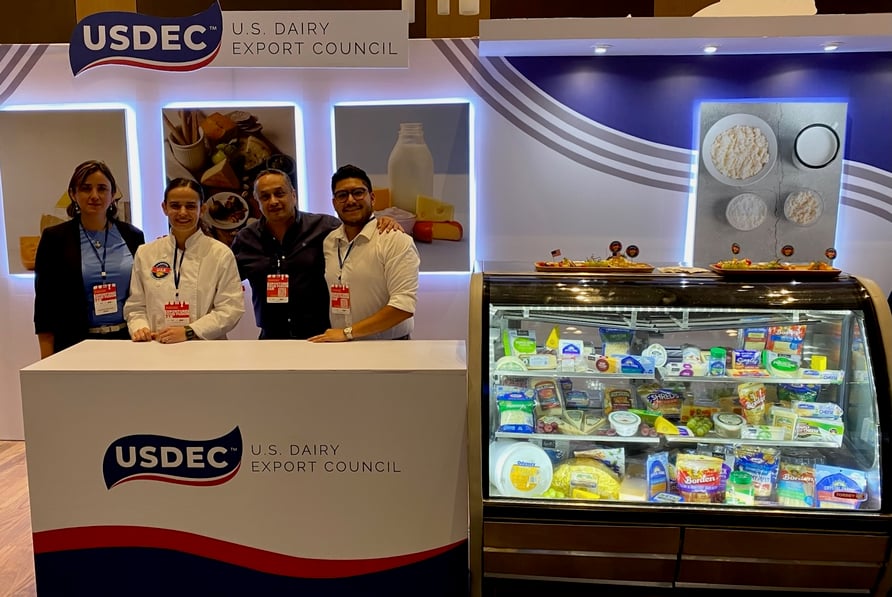
The USDEC booth at Convención Internacional de la Industria de Alimentos y Bebidas. Left to right: Valesca Faillace, USDEC Central America consultant/ingredient workshop trainer, and USDEC Mexico region staff Ana Maria Acevedo, Edgar Garcia and Emilio Leal.
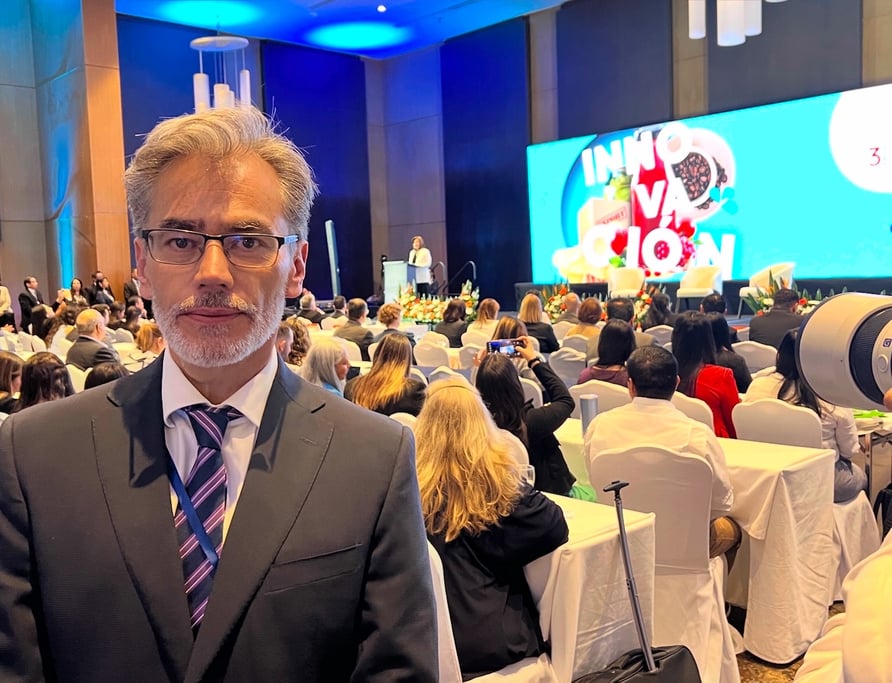
Chief of USDEC’s Mexico office, Rodrigo Fernandez, at the opening ceremony of the Guatemala food show.
USDEC applauds increased trade promotion funding in spending bill
USDEC applauded Congress for completing the reconciliation process on the One Big Beautiful Bill Act with funding intact for the new Supplemental Agricultural Trade Promotion Program. The bill establishes the program and provides $285 million in annual permanent funding. The new program complements USDA’s Market Access Program (MAP) and Foreign Market Development (FMD) Program, which are typically funded annually at about $235 million combined.
USDEC has consistently called for a bigger budget for export promotion (specifically MAP and FMD) for many years and supported the added funding for the new program.
“We are grateful for Congress increasing its investment in trade promotion funding, which is essential to expanding opportunities for U.S. dairy exports in competitive global markets,” USDEC President and CEO Krysta Harden said in a July 3 press release on the reconciliation bill. “This funding will help ensure that America’s dairy producers can reach more consumers around the world with high-quality, sustainably produced products, driving growth for the U.S. dairy industry and rural communities around the country.”
The additional funding is especially vital given the EU’s increased investment in public agri-food export promotion and new trade agreements signed by U.S. competitors that have put U.S. suppliers at a disadvantage in several key markets.
CCFN and USDEC continue common name defense at WIPO
USDEC’s Jaime Castaneda, in his role as executive director of the Consortium for Common Food Names (CCFN), attended the World Intellectual Property Organization (WIPO) General Assembly in Geneva, Switzerland, this week. CCFN (which was founded and is staffed by USDEC) has been engaging with WIPO for years, focusing on pushing back against the EU’s aggressive expansion of geographical indications (GIs).
Castaneda spoke at the General Assembly and participated in several meetings with country members and WIPO officials, including Deputy Director General Wang Binying. He also met with met with Angela Ellard, deputy director-general of the WTO, to discuss WTO issues and concerns and Ambassador Alfredo Suescum, chair of the WTO TRIPS Council (Trade-Related Aspects of Intellectual Property Rights), to discuss concerns about European actions to continue promoting the confiscation of common names. Castaneda was accompanied by Ambassador Al Johnson, former chief ag negotiator and CCFN consultant.
The U.S. recognizes that GIs can be a valuable tool for promoting authentic regional products, but their misuse to monopolize common names undermines free trade and distorts markets. Throughout the negotiations and discussions, Castaneda emphasized that many of these names—such as “parmesan” and “feta”—have become part of shared cultural and culinary heritage. They are not the exclusive property of any single region but rather generic terms that describe a style, recipe, or tradition recognized globally. Protecting the free use of these terms helps small and medium-sized producers stay competitive and honors the rights of consumers to know exactly what they are buying without unnecessary market confusion or artificial price hikes.
“In a time when global trade and open markets rely on fair use of generic terms, our work at WIPO is crucial to ensuring that farmers, cheesemakers, winemakers, and other food producers are not unfairly restricted by unjust naming claims,” says Castaneda.
Letter urges Senate approval of Lindberg
One hundred agricultural organizations, including USDEC and NMPF, signed a joint letter to U.S. Senate leaders urging them to expedite the confirmation of Luke Lindberg as USDA Under Secretary for Trade and Foreign Agricultural Affairs. USDEC and NMPF also coordinated a previous letter in support of Lindberg’s nomination in March to the chair and ranking member of the Senate Agriculture, Nutrition and Forestry Committee (see Global Dairy eBrief, 3/14/25). That committee’s subsequent unanimous approval of Lindberg attests to his bipartisan support.
The letter highlights Lindberg’s career as a proponent of using trade to strengthen U.S. agriculture, both as President and CEO of South Dakota Trade and in leadership positions with the Export-Import Bank of the United States.
“U.S. agriculture needs Mr. Lindberg to join Secretary Brooke Rollins and Deputy Secretary Stephen Vaden at USDA to champion American farmers, ranchers and agricultural producers as we continue to nourish the world with the most secure, affordable and nutritious food on the globe.”
USDEC meets with FAS attachés, spreads word on LatAm Nutrition Congress
On July 8, USDEC participated in the U.S. Agricultural Export Development Council (USAEDC) Global Attaché Policy Forum and Consultations in McLean, Virginia. Shawna Morris, executive vice president, Trade Policy and Global Affairs, Tony Rice, director, Trade Policy, and Sandra Benson, vice president, Market Access and Regulatory Affairs, took part in a series of meetings with USDA FAS attachés to highlight key dairy issues in each of their markets.
FAS and its attachés have long been key USDEC partners in the effort to build U.S. dairy export markets, and USDEC has played various roles in USAEDC meetings over the years.
On Thursday, USDEC held a breakfast briefing for FAS staff to publicize the USDEC-organized Latin American Nutrition Congress. The event, which is funded by USDA’s Regional Agricultural Promotion Program (RAPP), will take place in Peru this coming February and will feature prominent researchers from around the world sharing the most recent studies demonstrating the benefits of milk and milk products to health officials from the region. Daniel Whitley, FAS administrator, offered opening comments at the breakfast about the upcoming Congress. USDEC has been spreading the word to spark interest and attendance.
Events
USDEC 2025 events
For your convenience, USDEC has compiled a chronological list of dairy export-related member events currently slated for 2025. This list is effective as of July 11 and will evolve as new opportunities develop, funding is finalized, or unexpected changes arise.
JULY
- USDA Agribusiness Trade Mission, Dominican Republic, July 13-16, 2025
- U.S. Dairy Protein Nutrition Conference, Thailand, July 16
- Health Care Expo, Taipei, Taiwan, July 24-27
- Expo IAlimentos, Colombia, July 30-31, 2025
AUGUST
- Foodservice MENA Reverse Trade Mission, USA, Aug. 9-19, 2025
- Food Ingredients South America, Brazil, Aug. 26-28, 2025
SEPTEMBER
- U.S. Dairy Supply Seminar, Sept. 11, Ho Chi Minh City, Vietnam
- Korea, Hong Kong and Taiwan Reverse Trade Mission, USA, Sept. 13-20, 2025
- U.S. Dairy Supply and Innovation Seminar, Thailand, Sept. 15, 2025
- Food Ingredients Asia, Thailand, Sept. 17-19, 2025
- U.S. Dairy Innovation Seminar, Sept. 30, Ho Chi Minh City, Vietnam
- Espacio Food and Service, Chile, Sept. 30-Oct. 2, 2025
OCTOBER
- U.S. Dairy Protein Innovation Seminar, Taipei, Taiwan, Oct. 2
- U.S. Dairy Sustainability Conference: Unlocking Opportunities for Sustainable Dairy in Southeast Asia, Singapore, Oct. 7-8, 2025
- Food Tech Summit & Expo, Mexico, Oct. 8-9, 2025
- IDF World Dairy Summit, Chile, Oct. 16-25, 2025
- Ingredients Advisory Group Tactical Plan Meeting, Chicago, Oct. 21, 2025
NOVEMBER
- USDA Agribusiness Trade Mission, Mexico, Nov. 3-6, 2025
- U.S. Dairy Protein Nutrition Seminar, Nov. 4, São Paulo, Brazil
- Gulfood Manufacturing, Dubai, UAE, Nov. 4-6, 2025
- COP30, Brazil, Nov. 10-21, 2025
- Beverage Innovation Workshop, Singapore, Nov. 12-13, 2025
- Food & Hospitality China, Shanghai, Nov. 12-14, 2025
- World Cheese Awards, Bern, Switzerland, Nov. 13-15, 2025
- Mission to Market: Bulk Cheese Seminar (Japan and Korea), Nov. 17-21, 2025
DECEMBER
- 4th Quarter Joint USDEC Meeting of the Cheese and Consumer Products Advisory Committee and the Trade Policy Committee Meeting, Washington, D.C., Dec. 10-11, 2025
Market Summary
EU27+UK milk production nearly flat in May
With all but Latvia reporting, this year’s EU27+UK milk production peak was running pretty close to May 2024, with volume up just 0.1%, according to Eurostat data. Of the biggest producers, Germany, Italy and the Netherlands remain mired in long-term declines (due to a combination of extreme weather, disease and regulation), with May volume off by 1.7%, 3.4% and 0.4%, respectively. In addition, Poland posted its first YOY decline in more than four years in May, albeit just -0.4%. Solid growth by France (+2.1%), Ireland (+4.5%) and the UK (+5.8%) saved the day.
The increase was a disappointment, given 1.7% growth in April leading into the peak. With two major heatwaves striking the continent in June, EU27+UK production growth will be further challenged moving forward.
On the plus side for farmers, EU raw milk prices remain elevated. They held steady in May and inched up an estimated 0.2% in June.
Company News
Goulburn Valley Creamery investment doubles production capacity
Australia’s Goulburn Valley Creamery (GVC) invested A$20 million (about US$13 million) to double capacity at its Kyabram, Victoria, facility to more than 100,000 MT of raw milk per year. The company manufactures milk concentrates, ESL milk, fresh and frozen cream, and other products, targeting export markets, including Southeast Asia. The investment, which was supported by a $10 million grant from the Victorian government, allowed GVC to diversify its product lineup and added storage capacity as well. (Company reports; eDairyNews, 6/24/25)
ACCC clears potential Lactalis purchase of Fonterra consumer business
The Australian Competition and Consumer Commission’s (ACCC) reportedly cleared a potential purchase of Fonterra Co-operative Group’s consumer and foodservice businesses by Lactalis. An informal probe found that such an acquisition was unlikely to result in a “substantial lessening of competition.” Lactalis has been cited as one of several potential buyers for the operation (see Global Dairy eBrief, 5/9/25), which is valued at around NZ$4 billion (about US$2.4 billion). (Reuters, 7/10/25)
Baladna announces $250 million investment in Syria, new branch in Egypt
As part of its regional expansion strategy, Qatar-based agricultural company Baladna announced that its Board of Directors has approved a $250 million investment in an integrated industrial project to produce milk, dairy products and juices in the Syrian Arab Republic. The complex will also include a plastic packaging facility and a water treatment plant. The board also approved a plan to establish a new subsidiary in Egypt that will provide back-office support services to enhance Baladna’s operations across the Middle East and North African markets. (USDEC Middle East/North Africa office; Qatar Tribune, 7/3/25)
Mergers, acquisitions and joint ventures
To expand its presence in the Saudi Arabian market, Egyptian dairy company Juhayna Food Industries formed a strategic partnership with Saudi Arabian food distributor AlRashed Group. … In a move to strengthen its specialized nutrition portfolio, French dairy company Danone completed its acquisition of a majority stake in Kate Farms, a California-based maker of plant-based, organic nutrition products. … India-based Walko Food Co. acquired local ice cream business Meemee’s Ice Creams in a deal Walko officials said, marks its entry into India’s artisanal dessert market and further strengthens its portfolio of “innovative, handcrafted offerings.” … Australian private-equity firm Anacacia Capital acquired a majority stake in Australia-based dairy supplier Procal, which sells to retail, foodservice and manufacturing customers in the Australian states of Victoria and New South Wales from a site in Melbourne. The firm characterized its role in the transaction as “helping retired founders to sell a majority stake and partner the next generation to take the business up a level.” (USDEC MENA Office; Zawya, 7/7/25; Company reports; Just Food, 6/26/25, 6/9/25)
Company briefs
Texas-based Southern Dairy said it is considering building a 300,000-square-foot, $250 million dairy processing facility on 40 acres of land outside Watertown, New York. The proposed plant would produce milk powders, whey protein concentrate and other dry dairy products like infant formula. The company is also evaluating locations in other areas of the Northeast, Mid-Atlantic states and Midwest, but the New York site is reportedly its preferred location. … Australian ice cream maker Golden North announced plans to relocate its ice cream production to the former Beston Foods site in Murray Bridge. The company said the shift will allow for future growth, increased efficiency and product innovation while maintaining its South Australian identity. … Texas-based Hispanic cheese, meats and crema maker Cacique Foods appointed Pedro Silveira as its new CEO, succeeding Gil de Cardenas. Prior to joining Cacique Foods, Silveira was president of North America Ventures at Mondelez International and previously held leadership positions at Danone’s U.S. yogurt unit and Danone Canada. (USDEC Middle East/North Africa office; Dairy News Today, 7/9/25; eDairyNews, 7/2/25; Dairy Processing, 7/8/25)
In Case You Missed It...
U.S. Dairy Exporter Blog
Market analysis, research and news subscribe hereUSDEC Twitter feed
Follow us here.