HIGHLIGHTS: March 7, 2025
• Canada, Mexico and China tariff recap
• January U.S. dairy exports rise
• Letter supports Vaden USDA nomination
• Panama clarifies plant registration procedures
• Only one week left for Excellence in Exports nominations!
• USDEC booth traffic strong at Gulfood
• Trade mission helps build U.S. dairy business in China
• Member opportunity: Register for Seoul Food & Hotel 2025
• Member opportunity: Gulfood Manufacturing
• USDEC 2025 activity list
• Market Summary: GDT eases for second straight auction
• Market briefs: Aussie milk production; Czech, Slovak protests; South Korea births
• February updates to USDEC Export Guide
• Arla teams with Valley Queen
• Dairy alternative startups plot growth
• Company news: Synlait, Miraka, Fonterra, Mazoon, Subway
Featured
U.S. tariffs on most Mexican and Canadian imports postponed again; tariffs on imports from China implemented
At press time, President Trump had postponed most U.S. tariffs implemented earlier in the week on Canada and Mexico but maintained the additional 10% tariffs put in place on China. The tariff postponement applies only to products traded under the rules of the U.S.-Mexico-Canada Agreement.
The move is only temporary, according to the president, and some level of tariffs should begin again on April 2 as part of his Fair and Reciprocal Plan on tariffs. The move follows discussions the president had with Mexican President Claudia Sheinbaum and Canadian Prime Minister Justin Trudeau.
Retaliation status
Prior to the postponement, Mexico had yet to announce retaliation, and that situation is expected to continue at this stage. Canada, however, implemented the response it had announced in February when U.S. tariffs were initially scheduled to roll out. It immediately enacted 25% tariffs on C$30 billion in U.S. goods, including more than 60 dairy HS Codes, and sought public comment on another C$125 billion for a second wave of tariffs, which includes 60+ more dairy codes. At press time, Canada said it would align the C$125 billion wave of tariffs with the April 2 U.S. plan. Reports indicate Canada is expected to maintain retaliatory tariffs on the C$30 billion tranche for now. USDEC will alert members if this changes.
China's response was immediate as well. China implemented tariffs of 10-15% on 25 dairy HS Codes. Products that ship before March 10 and are imported into China between March 10 and April 12 are not subject to the tariffs.
USDEC released a Member Alert on March 4 listing all the affected HS Codes and implementation details. A second Member Alert on March 6 deals with the postponement.
USDEC actions
In a joint statement with NMPF on Tuesday March 4th regarding the initial developments, USDEC President and CEO Krysta Harden highlighted the critical importance of international markets to the U.S. dairy sector.
“Dairy farmers and manufacturers are counting on a swift resolution to this impasse and urge a redoubling of efforts at the negotiating table to find a workable way forward that addresses U.S. national security concerns while also preserving export flows that are vital to supporting American farmers and workers,” Harden said.
USDEC will continue to talk with the administration and Congress, as well as North American officials and industry partners, until all sides reach a full resolution. Since late last year USDEC has focused on engagement with Mexican authorities and stakeholders in particular, urging them to reach out to the new administration and come to an understanding that minimizes the risk of trade disruption. Additional discussions have taken place with Canadian stakeholders and officials this year as well, encouraging them to help persuade their government to establish high-level negotiations.
Reactions from affected governments
Canada's Trudeau and Mexico’s Sheinbaum each said the U.S. actions were unjustified. Trudeau said Canada was discussing the potential pursuit of several non-tariff measures as further retaliation and Canada also officially requested WTO consultations with the U.S. on the tariff issue.
A Chinese government official called the U.S. effort to exert pressure on China through tariffs “a miscalculation and a mistake.” But analysts characterized China’s retaliatory moves so far as a “measured response,” geared to deter escalation. (USDEC staff; Wall Street Journal, 3/6/25, 3/4/25; Reuters, 3/5/25, 3/4/25; Bloomberg, 3/3/25)
U.S. dairy exports eke out increase to start 2025
U.S. dairy exports kicked off 2025 with gains in almost all major product categories. But a poor month for nonfat dry milk/skim milk powder (NFDM/SMP) and lactose limited the overall volume increase to 0.4% (milk solids equivalent), compared to the previous year. Year-over-year (YOY) U.S. export value rose 20% to $714 million—a January record.
The biggest positive news in January remained cheese. YOY volume rose for the 13th straight month as shipments jumped 22% to 46,680 MT—a January record. In fact, every month since July 2024 has been a monthly cheese export record for U.S. suppliers.
Not only did volume post an impressive increase in January, the results highlighted broad market diversity. exports to Mexico, far and away the top U.S. cheese customer, grew just 1% (+70 MT). The vast majority of growth came from an impressive variety of destinations, including Japan (+59%, +2,133 MT), Middle East/North Africa (+93%, +1,743 MT), South Korea (+34%, +1,360 MT), Panama (+115%, +990 MT) and Australia (+21%, +553 MT).
January low-protein whey shipments built on December’s rebound when U.S. exports rose 6%. Strong demand from China helped lift total YOY U.S. low-protein whey exports by 14% (+5,404 MT) in January (after adjusting for the misclassification of some Chinese shipments of low-protein whey as WPC80+).
USDEC estimates total U.S. WPC80+ exports rose 19% (+1,094 MT) in January, after adjusting for the China misclassification. Revitalized Japanese demand fueled U.S. sales. U.S. exports of high-protein whey to Japan more than doubled to 2,009 MT, marking its largest single-month purchase since September 2023.
On the down side, NFDM/SMP recorded its second straight month with volume less than 50,000 MT, which, as noted last month, was a benchmark U.S. suppliers had not crossed since mid-2019. Weak U.S. NFDM/SMP production continues to hamstring U.S. opportunity in global milk powder markets.
Total January U.S. NFDM/SMP exports dropped 20% (-11,860 MT). While YOY NFDM/SMP exports to Mexico bounced back (+2%, +574 MT) after two negative months, shipments to other key destinations floundered, Southeast Asia in particular.
For more analysis of January results, read the U.S. Dairy Exporter Blog story, “U.S. dairy exports inch up to start 2025.” Also check out the interactive charts at the redesigned USDEC Data Hub under the Exports tab.
Letter supports Vaden nomination
On Monday, USDEC and NMPF joined a broad agricultural coalition in sending a letter supporting the nomination of Stephen Alexander Vaden as USDA Deputy Secretary of Agriculture. The letter, sent to the chair and ranking member of the Senate Agriculture, Nutrition and Forestry Committee and signed by 206 agricultural groups, emphasizes Vaden’s role as a serving judge on the U.S. Court of International Trade and his former position as General Counsel at USDA during the first Trump administration.
“His work addressing federal trade issues, including those involving agricultural commodities, will be indispensable as USDA continues to navigate global trade challenges and create a level playing field and expanded opportunities for U.S. farmers, ranchers and agribusinesses,” the coalition says.
The letter urges the Committee and the entire U.S. Senate to confirm the nominee promptly.
Panama clarifies plant registration procedure
On Jan. 14, the Panamanian Food Agency (APA) and the Ministry of Health (MoH) of Panama confirmed the expediting of the U.S. dairy plant registration process. This development resolves the trade barrier that negatively impacted USDEC members exporting to Panama in 2023. This positive outcome is the result of USDEC/MARA's collaboration with the Foreign Agricultural Service Panama office and ongoing engagement with regulatory officials from both the Ministry of Health and APA (see the USDA GAIN Report, “Streamlined Dairy Plants Registration in Panama.”) The revised process significantly reduces the estimated time to complete the registration to a maximum of two days, with the process now managed directly by APA without requiring approval from the MoH.
Only one week left to nominate for USDEC’s inaugural Excellence in Exports Awards
Don’t miss your chance to nominate your company or a colleague for the inaugural USDEC Excellence in Exports (ExEx) Awards. The March 15 deadline is quickly approaching. There are two awards categories: Excellence in Exports and Excellence in Innovation. If you have any questions about the nominating procedure or filling out the nomination forms, please contact Tom Quaife at tquaife@usdec.org.
The awards ceremony will take place April 8 at the USDEC Annual Members Meeting at the Willard InterContinental Hotel in Washington, D.C. For more information about the ExEx Awards, including more about the criteria for each award category, please click here.
Gulfood sets new attendance record; traffic high at USDEC booth
USDEC made a strong showing at Gulfood 2025, held from Feb. 17–21 at the Dubai World Trade Centre. Marking its 30th edition, the event drew an unprecedented international crowd, with attendance likely surpassing previous highs of over 100,000 visitors, potentially reaching up to 150,000.
USDEC’s participation featured 16 member companies at the U.S. dairy booth. Post-show feedback was overwhelmingly positive, with members giving very high marks to the quality of visitors. One member reported generating over 125 trade leads, underscoring the event’s value for business development in the region.
USDEC's booth stood out, with its second-floor area offering members a dedicated meeting space and lunches prepared by Chef Antonio El Khoury, USDEC’s director of Culinary Programs for the Middle East/North Africa (MENA) region. El Khoury also prepared recipe applications on members’ behalf.
“The booth buzzed with activity,” said Merle McNeil, USDEC senior vice president, Global Retail Programs. The energy was noticed by FAS Director Daniel Whitley, who expressed admiration for the engagement and activity surrounding it and its attendees.
“Gulfood 2025 proved a resounding success for USDEC and U.S. cheese suppliers, reinforcing their position in the global dairy market,” said McNeil.
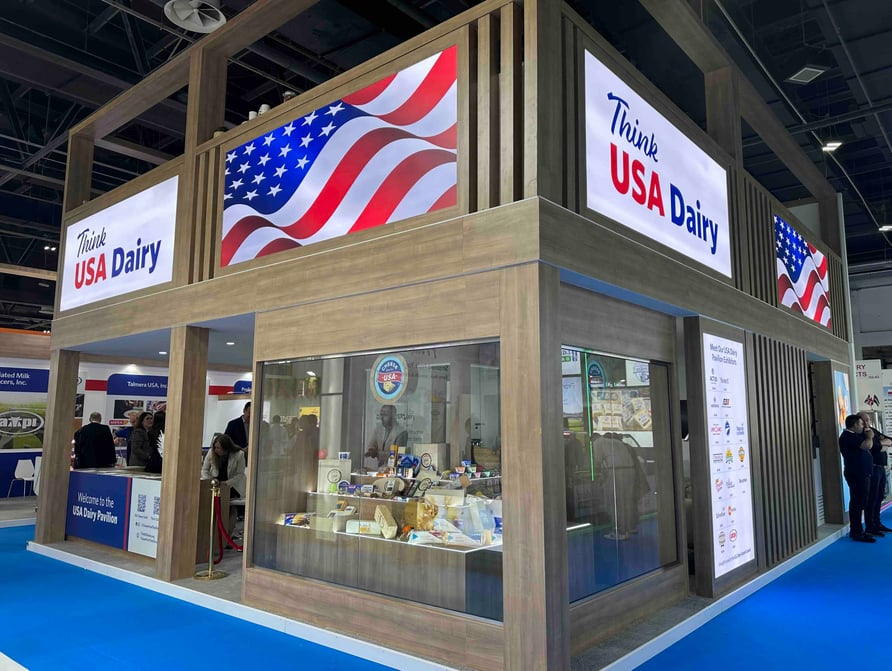
The USA Cheese Cave sits on the first floor of the two-level USDEC booth at this year’s Gulfood show. The “cave” featured member cheeses and varieties available in the Middle Eastern market.

The second level of the booth provided an area for members and USDEC staff to meet with clients and grab lunch.
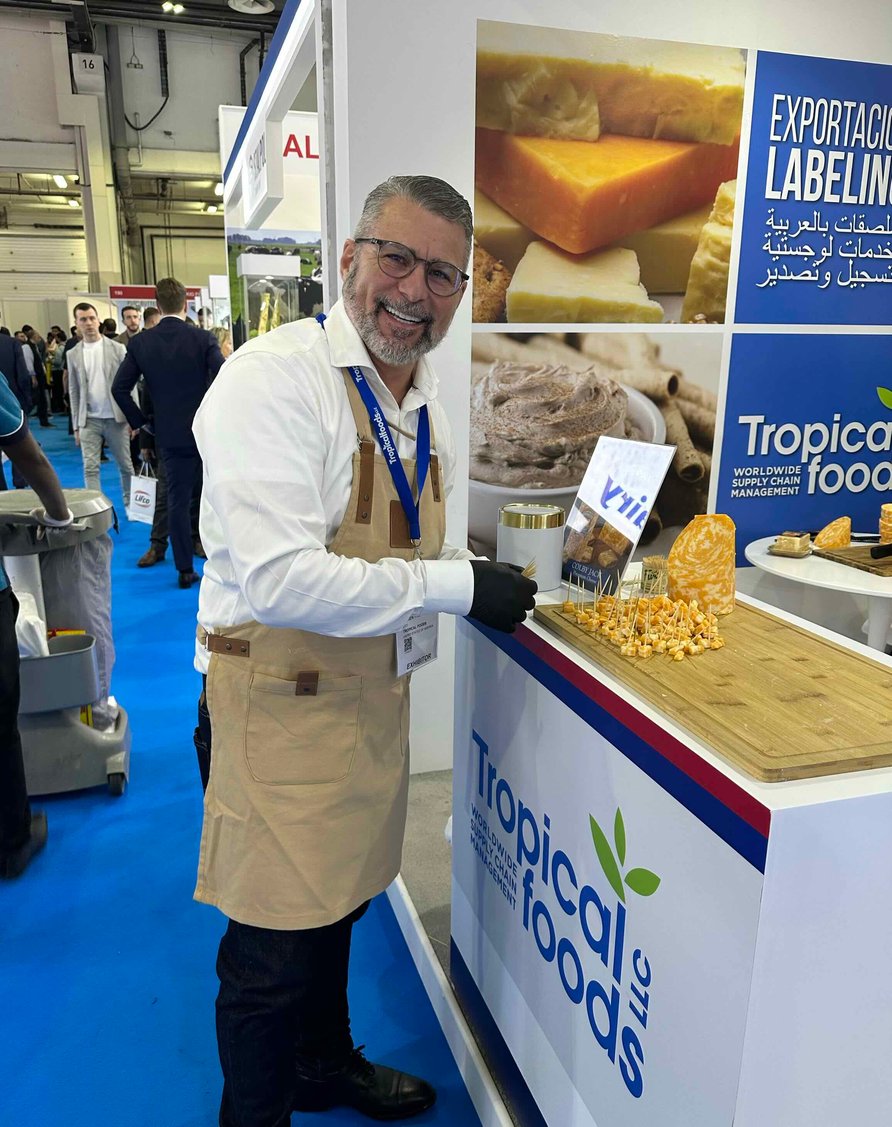
Daren Primoli, founder and CEO of USDEC member company, Tropical Foods, prepares cheeses to sample.
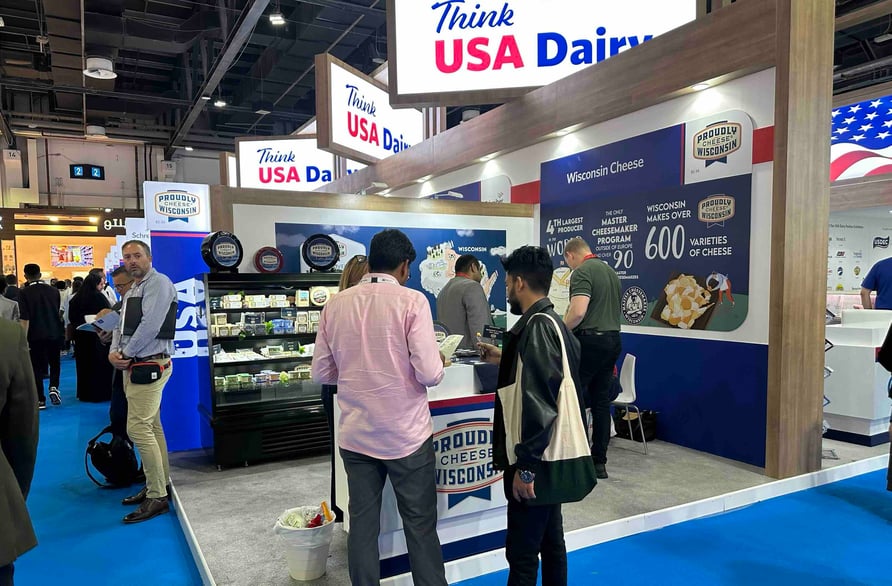
Companies reported more than 85% of business leads were made in the first three days.
Trade mission helps build U.S. dairy export business in China
The dairy-focused business development trip to China that took place last June (see Global Dairy eBrief, 6/28/24) is delivering results. The mission, run jointly by USDEC and USDA’s Foreign Agricultural Service (FAS), has helped U.S. dairy suppliers connect with Chinese buyers and strengthen trade relationships. Several sales have been linked to the trip, including cheese, lactose and WPC from three different U.S. suppliers. Another U.S. cheese supplier solidified an online sales agreement with a major Chinese e-commerce site covering nearly three-dozen retail cheese SKUs (with expectations for more) as well as whey protein.
Events
Registration open for USDEC’s USA Cheese pavilion at Seoul Food & Hotel 2025
USDEC will be hosting a USA Cheese pavilion at Seoul Food & Hotel 2025, taking place June 10-13. We will have six booths available to members, and spots will be determined by a lottery system.
Members interested in participating in USDEC’s USA Cheese pavilion must complete this form to enter the lottery by 5:00 p.m. ET on Wednesday, March 12—one entry per company. Members who do not complete the form by the deadline will only have their request for booth space considered after all members who filled out the form have been allocated a space or there is a cancellation.
How the lottery works
Spot allocation will be determined by random lottery through a secure platform called Random Picker. Companies will be notified of the results shortly after the lottery.
Please reach out to Nuhami Alemu (nalemu@usdec.org) with any questions.
Member sign-up for 2025 Gulfood Manufacturing opens March 17
Member registration to exhibit within USDEC’s booth at Gulfood Manufacturing in Dubai UAE will open on Monday, March 17, at 11 a.m. ET. Market opportunities for U.S. dairy ingredients are on the rise across MENA and Sub-Saharan Africa and Gulfood Manufacturing is one way U.S. suppliers can help increase their prominence as a supplier to these regions.
Building on the successful November 2024 U.S. Dairy Business Trade Mission to MENA, USDEC’s booth at Gulfood Manufacturing will provide strong visibility and engagement opportunities for participating USDEC members. At the 2024 show, an estimated 45,000 visitors and 2,500 exhibitors participated, making this one of the largest ingredient-focused trade shows in the world.
The show runs from Nov. 4-6, 2025. Booth space will be available for six members. Spaces are expected to fill quickly, so please reach out as soon as possible to indicate interest. While there are no fees to exhibit at the USDEC booth, members are responsible for any travel, lodging and shipping costs.
Please contact Suzanna Stohr at sstohr@usdec.org to indicate interest in booth space. USDEC will provide interested members with an activity participation agreement form (completion and submission thereof will be required to confirm the space). Space is limited, and USDEC will confirm participation on a first-come, first-served basis.
USDEC 2025 events
For your convenience, USDEC has compiled a chronological list of dairy export-related member events currently slated for 2025. This list is effective as of March 7 and will evolve as new opportunities develop, funding is finalized, or unexpected changes arise.
MARCH
- FoodEx Tradeshow, Tokyo, March 11-14, 2025
- Food Ingredients China (FIC), Shanghai, March 17-19, 2025
- Central America Supplier Mission, Guatemala, Costa Rica, Panama – March 16-25, 2025
APRIL
- USDEC Annual Membership Meeting, Washington, D.C., April 7-9, 2025
- Ingredients Advisory Group, Washington, D.C., April 9, 2025
- Cheese and Consumer Products Advisory Group, Washington D.C., April 9, 2025
- Food and Hotel Asia Tradeshow, Singapore, April 8-11, 2025
MAY
- Southeast Asia U.S. Dairy Proteins Healthy Active Aging Innovation Workshop, Singapore, May 7-8, 2025
- China Bakery Exhibition, Guangzhou, May 10, 2025
- USDA Agribusiness Trade Mission, Hong Kong, May 12-16, 2025
- China Animal Husbandry Expo (CAHE), Qingdao, May 19-21, 2025
JUNE
- USDA Agribusiness Trade Mission, Peru, June 9-12, 2025
- Seoul Food and Hotel Trade Show, Seoul, June 11-14, 2025
- International Cheese and Dairy Awards, Stafford, England, June 25-26, 2025
JULY
- USDA Agribusiness Trade Mission, Dominican Republic, July 13-16, 2025
- Expo IAlimentos, Colombia, July 30-31, 2025
AUGUST
- Food Ingredients South America, Brazil, Aug. 26-28, 2025
SEPTEMBER
- U.S. Dairy Supply and Innovation Seminar, Thailand, Sept. 15, 2025
- Food Ingredients Asia, Thailand, Sept. 17-19, 2025
- Espacio Food and Service, Chile, Sept. 30-Oct. 2, 2025
OCTOBER
- USDEC Sustainability Seminar, Singapore, Oct. 7-8, 2025
- Food Tech Summit & Expo, Mexico, Oct. 8-9, 2025
- IDF World Dairy Summit, Chile, Oct. 16-25
NOVEMBER
- USDA Agribusiness Trade Mission, Mexico, Nov. 3-6, 2025
- COP30, Brazil, Nov. 10-21, 2025
- World Cheese Awards, Bern, Switzerland, Nov. 13-15, 2025
DECEMBER
- USDA Agribusiness Trade Mission, Cote D’Ivoire, Dec. 8-11, 2025
- 4th Quarter Joint USDEC Meeting of the Cheese and Consumer Products Advisory Committee and the Trade Policy Committee Meeting. Dec. 10-11, Washington, D.C.
Market Summary
GDT eases for second straight auction
The Global Dairy Trade (GDT) Price Index fell 0.5% at the March 4 auction, as China pulled back after dominating the previous event and Southeast Asia maintained the lower profile it assumed on Feb. 18.
Whereas one or two regions typically set the buying tone, this week’s event featured four different top purchasers across the major product categories. The EU led SMP purchasing; Southeast Asia topped AMF volume; the Middle East was the largest butter customer; and North Asia (China) led in WMP and cheddar.
The EU had its strongest showing on the GDT in some time, accounting for 20% of volume sold, led by SMP. The Middle East accounted for 16% of volume. Both Chinese and Southeast Asian percentages—28% and 25%, respectively—were down from the previous auction as well as the same auction last year.
Although the March 4 auction nearly matched the 0.6% GDT Price Index decline on Feb. 18, commodities generally outperformed SGX-NZX expectations heading into the event. The fall centered on flagship WMP. The average winning WMP price fell 2.2% to US$4,061/MT but remains above the notable US$4,000/MT reference point. While China led WMP buying, its appetite fell 37% from the previous auction and 50% from the same auction last year.
SMP held its own with a 0.6% increase in the GDT Index, driven by strong EU interest. Butter recorded its second consecutive record high, rising 2.7% to US$7,577/MT in the face of strong global demand and limited supply.
Cheese also performed well, with cheddar up 1.1% (to US$4,915/MT) and mozzarella jumping 7.9% (to US$4,477/MT, its highest price since November 2024).
Market condition briefs
Here is a quick rundown of recent dairy supply and demand developments from around the world:
- Year-over-year (YOY) Australian milk production fell 2.6% in January. Not only was it the third straight monthly decline, but also the shortfall is accelerating. YOY output fell 0.2% in November, 1.0% in December and now 2.6%. Season to date (July 2024-June 2025) Australia is still up 0.4%, but if the current downtrend continues as expected, the country will slip into the red for the year in February.
- Czech and Slovak farmers parked dozens of tractors and disrupted operations at the Czech-Slovak border and a Polish crossing last week to protest European Union policies they say are hurting their livelihoods. The protests, which also included farmers from Hungary and Austria, were largely due to dissatisfaction with the recent agreement struck between the EU and South America's Mercosur bloc, as well as what farmers say is “unfair” competition from Ukrainian imports that are exempt from duties. Farmers were also protesting bureaucracy related to the EU’s climate strategy.
- South Korea’s fertility rate improved for the first time in nine years in 2024. It had dropped from 1.24 in 2015 to 0.73 in 2023, the lowest in the world, before reversing course to 0.75 last year. A government effort to encourage young people to marry and have children helped turn things around, but South Korea has a long way to go to fix its demographic challenge. It remains the only country in the Organization for Economic Cooperation and Development with a rate below 1. (Dairy Australia; Reuters 2/27/25; 2/26/25)
Market Access and Regulatory Affairs
Latest changes to the USDEC Export Guide
The MARA team updated or revised 192 documents in the USDEC Export Guide in February. Here are some highlights:
Volume 1: Tariffs and Classification
- Canada: 25% retaliatory tariff added most dairy categories.
- China: Additional 10% retaliatory tariff added to most dairy categories, except whey, permeate, WPC 34 and WPC 72 under HS Code 04041000, and lactose under HS Code 1702. Additionally, China's automatic retaliatory tariff exemption for U.S. permeate for feed has expired, and an extension has not been announced.
Volume 2: Import Requirements
- Malaysia: Updated new facility registration questionnaire and added a reference document pertaining to the General Procedure to Import Milk Products into Malaysia.
- Morocco: Added information on why the U.S. government is unable/unwilling to sign the documentation Morocco requires, as well as a reference to FAS's ongoing efforts with Morocco to reach a solution.
Volume 3: Labeling and Product Standards
- Brazil: Added general labeling guidelines on the declaration of functional property claims for nutrients with fully recognized functions on the labeling of packaged foods.
- China: In Formula Foods for Special Medical Purposes, added new labeling requirements for Nutritionally Complete Food for Special Medical Purposes.
Every month, USDEC’s Market Access team emails a list of guide updates to interested members. If there is anyone at your company who should be included on the distribution list for that email in the future, please contact Jessica Smith at jsmith@usdec.org.
Company News
Arla Foods Ingredients boosts U.S. presence with Valley Queen deal
To strengthen its ability to meet the growing demand for protein-enriched dairy in the U.S., Denmark-based Arla Foods Ingredients signed a contract manufacturing agreement with South Dakota-based dairy processor Valley Queen. Under the agreement, Valley Queen will produce ingredients from the Nutrilac ProteinBoost product range, a whey protein concentrate line designed to increase protein levels in foods and beverages while retaining texture and taste. Production is expected to begin at the company’s Millbank, S.D., plant in winter 2025/2026, after new specialty equipment has been installed. (Company reports)
Dairy alternative startups reveal new technology, growth
After Dutch ingredients startup Vivici announced it received new funding to expand its ability to create dairy protein from precision fermentation last week (see Global Dairy eBrief, 2/28/25), two more startups revealed new innovation and growth plans.
In Boston, cellular agriculture startup Brown Foods announced its new lab-made UnReal Milk, a dairy alternative achieved through a “biotech-driven approach called mammalian cell culture.” The company said that unlike precision fermentation, this technology creates a product that contains the same dairy proteins, fats and carbohydrates found in cow’s milk and can be “scaled up further using bioreactor systems to produce mass volumes” for human consumption. Brown Foods plans to bring UnReal Milk to consumers for tasting late this year, with a market pilot planned for late 2026.
And New Zealand food-tech startup Daisy Lab, which includes Waikato dairy cooperative Tatua as an investor, announced it aims to scale its precision fermentation operations from its current 10-liter production facility to a 1,000-liter pilot plant by the end of the year. (Dairy Processing, 2/25/25; RNZ, 2/26/25)
Company Briefs
New Zealand-based Synlait Milk appointed Richard Wyeth as its new CEO. Wyeth, who has previously served as CEO of both Westland Milk Products and Taupo-based dairy company Miraka, will join Synlait on May 19. … In an unrelated move, Miraka CEO Karl Gradon stepped down from his role for personal reasons. COO Richard Harding was named acting chief executive while the company searches for a permanent replacement. … New Zealand’s Fonterra announced the discontinuation of its “carbon zero milk” claim for its Simply Milk range after the company acknowledged it failed to meet emissions reduction targets for the product last year. The company has instead rebranded the product to emphasize a 10-cent per bottle donation to “social supermarkets”—akin to food pantries. … Subway China plans to add 300-500 new stores per year as it enters a period of rapid expansion in the country. … Oman Air signed an agreement with Oman’s Mazoon Dairy for Mazoon to serve as the airline’s official supplier of dairy products including milk, yogurt, laban and cheese. … Kenya-based Kinangop Dairy Ltd. introduced Kinangop Gold Yoghurt, a new range of premium dairy products that aims to appeal to a range of consumer taste preferences. The new line includes pineapple, vanilla, strawberry, lemon biscuit and chocolate flavors. … To address the challenges posed by excess milk production and provide employment opportunities in the region, Ugandan President Yoweri Kaguta Museveni officially inaugurated the BENNI Foods dairy processing factory in Kiruhura District. The site currently employs 73 youths, with plans to expand job opportunities as the company progresses beyond its initial test phase. (USDEC Middle East/North Africa office; USDEC China office; Company reports; Farmers Weekly, 3/5/25; Rural News Group, 3/5/25; TradeArabia, 3/3/25; Dairy Business Africa, 2/28/25)
In Case You Missed It...
U.S. Dairy Exporter Blog
Market analysis, research and news subscribe hereUSDEC Twitter feed
Follow us here.