HIGHLIGHTS: FEBRUARY 28, 2025
• Latest on Canada, Mexico tariffs; new China shipping fees
• Sweet snacks workshop kicks off new year of U.S. CDE activities
• Bill introduced to restart trade talks with UK
• Doud and Howrigan talk dairy trade priorities with Congress
• Indonesia begins enforcing prior notice rules
• Philippines to implement digital verification and invoicing system
• Don’t miss one-on-one opportunity to meet with USDEC overseas offices
• Member opportunity: USDA trade mission to Peru
• USDEC 2025 activity list
• Market Summary: International Demand Analysis shows dairy trade up in 2024
• NZ starts new dairy export year strong
• USDEC posts 2025 signposts outlook
• EU announces more farmer-friendly ag vision
• Market briefs: NZ farmer confidence soars, Chinese milk producers flounder, and more
• ILA membership approves new contract
• Fonterra announces new emissions reduction payments
• Arla invests in UHT, lactose-free
• Corporate report recap: Danone, Emmi, Glanbia
• Company news: Mengniu, Vivici, Feihe
Featured
Mexico, Canada tariff deadline imminent; new fees announced on Chinese shipping
At press time, it was still unknown whether the United States would move ahead with 25% tariffs currently scheduled to take effect on all goods from Canada and Mexico on March 4. In a social media post on Thursday, the president reinforced the March 4 date, saying that’s not only when the Mexico and Canada tariffs would go into effect but also when the U.S. would implement an additional 10% tariff on Chinese goods. The “Fair and Reciprocal Plan on Trade” (see Global Dairy eBrief, 2/14/25), he added, was still expected to move forward on April 2.
U.S. negotiations with Canada and Mexico on the proposed 25% tariffs are ongoing. USDEC continues to engage with the administration to preserve North American trade flows while encouraging a tailored approach to tariffs that recognizes the key role exports play for U.S. dairy farmers, processors and workers.
Chinese shipping fees
Separately, the Trump Administration announced a proposal to impose fees of up to $1 million every time a Chinese-owned vessel enters a U.S. port and up to $1.5 million every time a Chinese-built ship enters a U.S. port. It also mandates that a certain amount of U.S. exports are moved on U.S.-flagged and U.S.-built vessels each year. The proposal is aimed at discouraging reliance on Chinese shipping and helping revive the U.S. shipbuilding industry.
More than half of new cargo ships, tankers and other ocean-going vessels built in 2023 were constructed in China, although a smaller percentage (about 20%) of container vessels arriving at American ports are made in China. Currently, less than 2% of U.S. trade annually moves on U.S.-flagged vessels.
The proposal, which is likely to elevate shipping costs significantly, is the result of an investigation (started during the Biden administration) into the dominance of the Chinese shipping industry, in response to a petition filed by labor unions. It is open to public comment until a March 24 hearing. (New York Times, 2/26/25; Politico, 2/24/25; Wall Street Journal, 2/24/25; Bloomberg, 2/24/25)
U.S. CDE holds first ingredients workshop of 2025 on sweet snack innovation
This week’s U.S. Dairy Ingredients Sweet Snacks Innovation Workshop brought 20 R&D professionals from five Southeast Asian countries to the U.S. Center for Dairy Excellence in Singapore for two days of U.S. dairy ingredient education and investigation. Themed “Discovering the Whey to Healthier Sweet Snacks with U.S. Dairy Proteins and Ingredients,” the workshop focused on exploring ways to use U.S. dairy to create local-friendly bakery and confectionery products that are both health-and-wellness positioned and indulgence oriented while also fitting the needs, desires and lifestyles of Southeast Asian consumers.
Day 1
Dali Ghazalay, regional director, USDEC Southeast Asia, and Vikki Nicholson-West, USDEC senior vice president of Global Ingredients Marketing, kicked off the event with welcome remarks. Jamie Lee, senior program manager, USDEC Southeast Asia, then presented an overview of USDEC’s mission, programs and how the USDEC Southeast Asia office can help customers in the region.
Deep dives into innovating sweet snacks using U.S. dairy ingredients followed. Martin Teo, senior director, Food Applications and Innovation–USDEC Southeast Asia, and Calista Foo, food technologist, USDEC Southeast Asia, highlighted the functional and sensory properties, nutritional advantages, versatility, prototype concepts and usage tips for U.S. dairy proteins, permeate, and SMP.
“Innovation is critical to win consumers and ensure businesses do not get left behind on trends and opportunities,” Teo said. “U.S. dairy ingredients can help lead the way.”
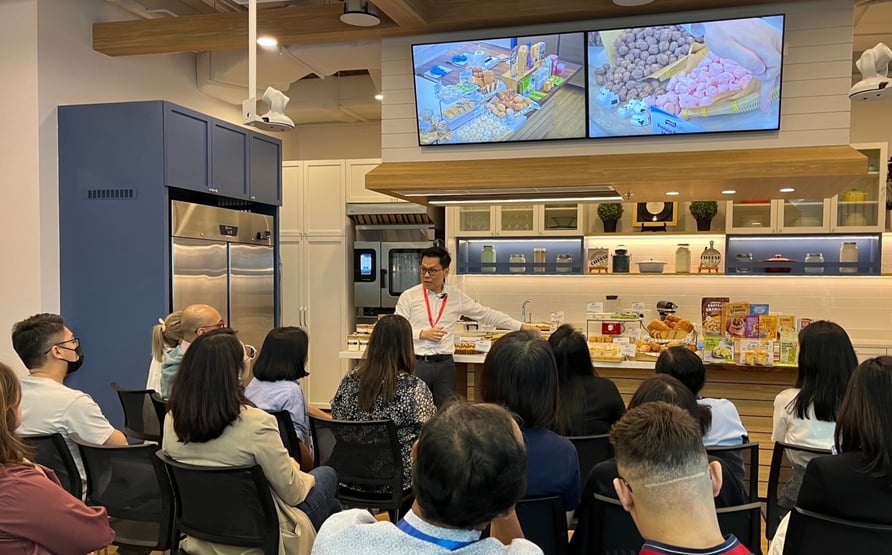
As part of the product showcase, Martin Teo walks participants through an array of “health-ified” local-friendly sweet snacks (on the counter) made with U.S. dairy proteins, SMP and permeate and how those ingredients offer wide-ranging innovation potential.
Anoo Pothen, director of Consumer Insights, reviewed USDEC consumer research data on Southeast Asian bakery and confectionery preferences and desires, examining opportunities for products that balance nutrition, health and indulgence. (Click here to access USDEC’s “Bakery Landscape in Southeast Asia” research report for more information.)
Siew Guan Lee, extension educator, University of Idaho Extension–Twin Falls (who is spending part of her sabbatical at the U.S. CDE), reviewed key considerations for formulators when innovating “healthful” products, with an emphasis on protein needs but also sodium, fat and sugar levels. Lee emphasized the importance of protein quality when selecting protein sources and how dairy proteins stand out as a nutritionally complete and quality protein that contains all essential amino acids.
Participants sampled—and indicated they were impressed by—an array of local-friendly sweet snack concepts developed by USDEC Southeast Asia that demonstrated the potential for using U.S. dairy ingredients to create good-tasting, “health-ified” products with consumer appeal. They also got to see and learn about mainstream commercial products from Northeast Asia, the United States, Brazil, Europe and Southeast Asia that already use dairy proteins and permeate. Such real-life examples reinforce the viability of innovation with dairy ingredients in sweet snack applications. (Note for members: USDEC staff welcomes the opportunity to display commercial products made with your ingredients as part of future showcases.)
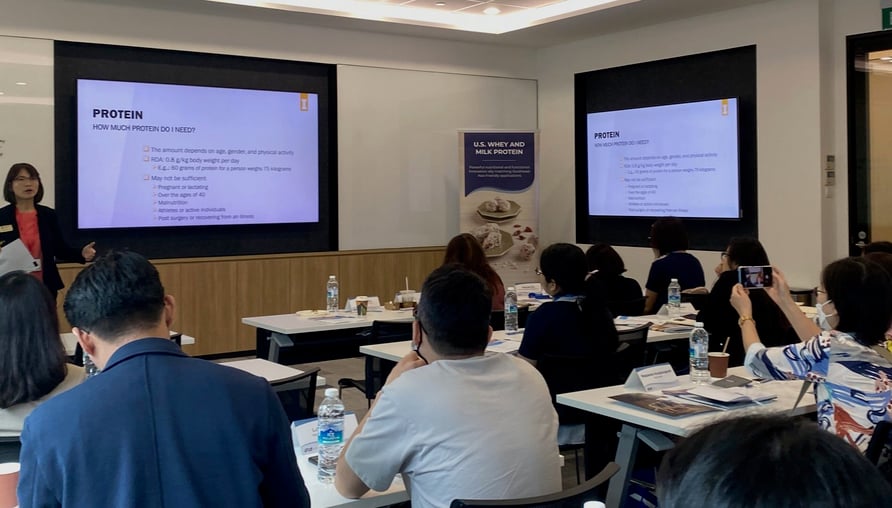
Siew Guan Lee (standing, left) relays the importance of protein quantity, quality and intake timing as factors to consider when formulating healthful bakery and confectionery products.

Attendees sample some of the local-friendly sweet snacks developed by USDEC Southeast Asia office staff.
Day 2
On Day 2, Mike Fleming, a Singapore-based bakery expert and director of BakeAsia Consultancy, joined Foo and Teo for a more focused look at how to utilize U.S. whey protein as an egg replacer in bakery formulations as well as its potential for use in gluten-free bakery products. This included an educational session showing the results of trials conducted at the U.S. CDE for protein-added butter cakes and bread, as well as a tasting session comparing a control product made with eggs/gluten and the non-egg/non-gluten versions of cakes and breads made with U.S. whey protein.
Test kitchen demos illustrated ingredient performance differences between egg whites and U.S. whey protein isolate for product characteristics such as aeration properties. After the presentations, participants expressed interest in the benefits of egg replacement. (Click here for the USDEC report, “Whey Protein as an Egg Replacer Guidelines.”)

Mike Fleming and Calista Foo walk attendees through a demonstration of an eggless, gluten-free butter cake developed at the U.S. CDE.

Foo and Teo show the results of the whippability test comparing U.S. WPI and egg whites.
Later that morning, participants split into breakout groups to ideate new sweet snack product ideas that incorporate U.S. dairy proteins. The groups formulated product concepts while also identifying target market segments, product positioning, development processes, texture, taste and flavor considerations, and more.
Teo, Lee and Kristi Saitama, USDEC vice president, Global Ingredients Marketing, judged the concepts the groups developed, eventually naming two winners. A nutritionally balanced, mango-coconut-chocolate protein crisp extruded snack (targeting children five and older) won for the most innovative product concept. It contained WPI, permeate and sweet whey. The judges also recognized a high-protein, bite-sized, alphabet-shaped cookie (milk, chocolate and strawberry flavors) for the creativity of the marketing plan. The product, made with WPI, permeate, and MPC/MPI, was positioned for children to learn while eating.

Teo (left) and Lee (right) recognize the team that won for best marketing plan during the workshops’ product ideation exercise.

Attendees, USDEC staff and presenters from this week's U.S. Dairy Ingredients Sweet Snacks Innovation Workshop at the U.S. CDE.
Saitama began the afternoon with an overview of the U.S. dairy industry, why it is ideally suited to be the supplier of choice for customers in Southeast Asia, and its long-term commitment to working with customers for win-win success. The workshop concluded with presentations from and one-on-one meetings with seven U.S. member companies who participated in the workshop.
In their closing comments, the R&D personnel indicated that the workshop opened their eyes to new opportunities and said they were eager to explore U.S. dairy ingredient usage further when they went back to their companies.
The next ingredient innovation workshop at the U.S. CDE will take place May 7-8 and will focus on the healthy active-aging market opportunities using U.S. dairy proteins. For more information or to inquire about sharing commercial consumer packaged goods product examples for display purposes, contact please contact Suzanna Stohr (sstohr@usdec.org) or Kristi Saitama (ksaitama@usdec.org).
Bipartisan, bicameral bill introduced to restart trade talks with the UK
House Ways and Means Trade Subcommittee Chair Adrian Smith (R-NE) and Rep. Jim Himes (D-CT) and Sens. Jerry Moran (R-KS) and Chris Coons (D-DE) introduced bipartisan legislation on Thursday that authorizes the administration to negotiate a comprehensive trade agreement with the United Kingdom. The Undertaking Negotiations on Investment and Trade for Economic Dynamism (UNITED) Act would provide the United States an opportunity to reenter into the bilateral trade negotiations that began under the first Trump administration. The legislation also includes a “Sense of Congress” clause that states the United States “should pursue more open trade and investment relationships with its allies.”
The United Kingdom is among the world’s largest cheese importing countries, yet high tariff and nontariff trade barriers currently limit U.S. exports to the market. USDEC and NMPF have endorsed the legislation in support of efforts to open the market to American dairy exporters.
Doud and Howrigan highlight dairy trade priorities to Congress
This week, Dairy Farmers of America dairy farmer Harold Howrigan from Vermont and NMPF President and CEO Gregg Doud testified, respectively, at hearings before the Senate Agriculture, Nutrition and Forestry Committee and the House Ways and Means Subcommittee on Trade.
Doud submitted 14 pages of detailed written comments to the House subcommittee highlighting the vital role exports play in the health of the U.S. dairy sector and how the U.S. government can help U.S. dairy trade grow and thrive to the benefit of U.S. dairy producers, workers and exporters.
New Zealand and the EU have been successfully negotiating trade agreements with key dairy-importing countries for more than a decade to expand market access opportunities, the comments state. It’s an area where the United States has fallen behind in the effort.
“To keep up with our competitors from Europe and New Zealand, U.S. dairy exporters need new trade deals that cut tariffs and tackle nontariff trade barriers,” Doud said. Whether the U.S. pursues broader agreements or more targeted ones “tariff reductions for our dairy exporters are essential to fair global competition, particularly in regions such as Southeast Asia, the Middle East and the UK.”
Doud also detailed specific agreements for the U.S. government to prioritize greater enforcement of existing trade agreements, including:
- Fixing the United States’ deeply imbalanced agricultural trade relationship with the EU.
- Ensuring Canada holds up its end of the bargain on dairy in the U.S.-Mexico-Canada Agreement by fixing both tariff rate quota issues into Canada and the excessive offloading of artificially low-price Canadian dairy protein into the U.S. and global markets.
- Following through with China on increasing its purchases of U.S. dairy products, ensuring timely facility listing updates, and providing protection for common names.
- Resolving India’s longstanding high tariffs and unscientific certification requirements.
Howrigan’s testimony to the Senate (and written comments) covered a range of dairy farming concerns, including the vital role of export markets to the health of the U.S. dairy sector and some of the key current challenges to U.S. dairy export growth in foreign markets.
He called on the administration to address issues like the EU’s attempts to monopolize common names, the huge U.S. dairy trade imbalance with the EU due to tariff and non-tariff barriers, Canada’s use of loopholes to “persistently refuse to honor its dairy trade obligations” and the need to continue and expand funding of USDA’s Market Access Program, Foreign Market Development Program and Regional Agricultural Promotion Program.
Indonesia Quarantine Agency begins enforcing prior notice rules
As of Feb. 6, 2025, the Indonesia Quarantine Agency (IQA) has begun enforcing IQA Regulation No. 14/2024, requiring U.S. exporters to submit Prior Notice (PN) before the vessel departs U.S. ports. To assist with this transition, IQA has updated the PN portal to allow for amendments after submission but before the ship arrives in Indonesia, if needed. The new regulation also adds detailed requirements affecting health certificates.
USDEC strongly urges members to work closely with importers to ensure shipments are in compliance with the regulation. USDEC is engaged with FAS in Jakarta and the Indonesian government to clarify these requirements and will provide updates to the membership as needed.
For more information, download the Feb. 20 USDA GAIN report, “Indonesian Prior Notice Must Now Be Submitted Before Vessel Departs U.S. Port with Other Requirements Beginning June 6.” Please contact Aimee Pinkerton at apinkerton@usdec.org with additional questions.
Philippines implementing digital system for pre-border verification and cross-border invoicing
On Jan. 20, the Philippines outlined procedural requirements for a 2024 Administrative Order (AO) that mandates the development of an integrated digital system for pre-border technical verification (PTV) and a cross-border electronic invoicing (CEI) system for all imported commodities.
Exporters must register in the CEI portal and create a consignment-specific “Certificate of Conformity” through this platform before each shipment is exported to the Philippines. Individual consignment testing is not required.
The AO also introduced a PTV system to guarantee the safety and quality of commodities exported to the Philippines. To support compliance with the system, third-party testing, inspection and certification (TIC) companies will inspect all commodities before their export to the Philippines. As of this publication, the portal is not online and there is no list of accredited TICs to support the document reviews.
USDEC has been monitoring developments and although the Philippines did not follow the required notification procedures, USDEC participated in several public consultation events and submitted formal industry comments, addressing the impact these requirements will have on members. In collaboration with the U.S. government, USDEC raised concerns to the Department of Finance and continues to escalate this issue within the Philippine government.
For more information, download the Feb. 18 FAS GAIN report, “Philippines Issues the Implementing Guidelines of the Pre-Border Technical Verification and Cross-Border Electronic Invoicing of All Imported Commodities.” Please contact Aimee Pinkerton at apinkerton@usdec.org with additional questions.
One-on-one slots with USDEC overseas office reps filling up fast
Don’t miss out on a chance to meet one-on-one with USDEC’s overseas office representatives at the USDEC Annual Membership Meeting at the Willard Hotel in Washington, D.C., April 7-9. Eight international representative offices will be available for 25-minute one-on-one sessions with members. Book now because reserved time slots are starting to fill up.
The sessions are divided into two blocks:
- Monday, April 7, from 8:00 a.m. to 2:30 p.m.
- Wednesday, April 9, from 12:40 p.m. to 4:00 p.m. (after the advisory group meetings)
To select which office you would care to meet with and reserve your time, please click here. Each member can reserve one 25-minute slot per office. Please make sure to read the instructions before selecting.
For more information on the Annual Membership Meeting, click here. The landing page includes a brief description of the event as well as links to register and download the preliminary agenda.
Events
USDA accepting applications for Peru agribusiness trade mission
USDA’s Foreign Agricultural Service (FAS) is inviting U.S. ag exporters to participate in a June 9-12 trade mission to Peru. Participants will join buyers from Peru, Bolivia and Ecuador for targeted business-to-business meetings to explore and discuss potential business opportunities in each country.
FAS-sponsored international trade missions aim to connect U.S. agricultural suppliers with prospective customers, giving U.S. companies the opportunity to forge relationships, gather market intelligence and generate sales. In addition to the B2B meetings, the mission includes in-depth market briefings by FAS staff, site visits and networking events. For more information on the trip, including an online application form, click here. The application deadline is Wednesday, March 12.
USDEC 2025 events
For your convenience, USDEC has compiled a chronological list of dairy export-related member events currently slated for 2025. This list is effective as of Feb. 28 and will evolve as new opportunities develop, funding is finalized, or unexpected changes arise.
MARCH
- USDA Agribusiness Trade Mission, Guatemala, March 3-6, 2025
- FoodEx Tradeshow, Tokyo, March 11-14, 2025
- Food Ingredients China (FIC), Shanghai, March 17-19, 2025
- Central America Supplier Mission, Guatemala, Costa Rica, Panama – March 16-25, 2025
APRIL
- USDEC Annual Membership Meeting, Washington, D.C., April 7-9, 2025
- Ingredients Advisory Group, Washington, D.C., April 9, 2025
- Cheese and Consumer Products Advisory Group, Washington D.C., April 9, 2025
- Food and Hotel Asia Tradeshow, Singapore, April 8-11, 2025
MAY
- Southeast Asia U.S. Dairy Proteins Healthy Active Aging Innovation Workshop, Singapore, May 7-8, 2025
- China Bakery Exhibition, Guangzhou, May 10, 2025
- USDA Agribusiness Trade Mission, Hong Kong, May 12-16, 2025
- China Animal Husbandry Expo (CAHE), Qingdao, May 19-21, 2025
JUNE
- USDA Agribusiness Trade Mission, Peru, June 9-12, 2025
- Seoul Food and Hotel Trade Show, Seoul, June 11-14, 2025
- International Cheese and Dairy Awards, Stafford, England, June 25-26, 2025
JULY
- USDA Agribusiness Trade Mission, Dominican Republic, July 13-16, 2025
- Expo IAlimentos, Colombia, July 30-31, 2025
AUGUST
- Food Ingredients South America, Brazil, Aug. 26-28, 2025
SEPTEMBER
- U.S. Dairy Supply and Innovation Seminar, Thailand, Sept. 15, 2025
- Food Ingredients Asia, Thailand, Sept. 17-19, 2025
- Espacio Food and Service, Chile, Sept. 30-Oct. 2, 2025
OCTOBER
- USDEC Sustainability Seminar, Singapore, Oct. 6-9, 2025
- Food Tech Summit & Expo, Mexico, Oct. 8-9, 2025
- IDF World Dairy Summit, Chile, Oct. 16-25
NOVEMBER
- USDA Agribusiness Trade Mission, Mexico, Nov. 3-6, 2025
- COP30, Brazil, Nov. 10-21, 2025
- World Cheese Awards, Bern, Switzerland, Nov. 13-15, 2025
DECEMBER
- USDA Agribusiness Trade Mission, Cote D’Ivoire, Dec. 8-11, 2025
- 4th Quarter Joint USDEC Meeting of the Cheese and Consumer Products Advisory Committee and the Trade Policy Committee Meeting. Dec. 10-11, Washington, D.C.
Market Summary
Global dairy trade finishes 2024 up 1.4%
An end-of-year surge in New Zealand dairy exports lifted world dairy trade to a 1.4% increase in calendar year 2024, according to USDEC’s International Demand Analysis released Tuesday. Year-over-year (YOY) New Zealand dairy exports rose 9.4% in December, while EU trade inched up 0.5%. The U.S. was the lone member of the Big Three suppliers to post a YOY decline: -2.0%.
New Zealand benefitted most from China’s late-year import demand rebound. Overall dairy shipments to China rose 15% in the fourth quarter compared to the previous year. China’s rebound also looks like it has spilled over into 2025 based on New Zealand’s January export data (see below).
USDEC expects modest recovery in 2025 from China, which, coupled with easing inflation globally, rising global cheese and dairy protein demand, and a recovery in U.S. milk production, set the stage for U.S. and international dairy trade growth in 2025.
For more on December and full-year results, download the International Demand Analysis. The report is packed with charts, graphs and commentary, providing members with a forward-looking glimpse at world markets from a U.S. exporter’s point of view. It analyzes demand in the key markets for cheese, NFDM/SMP, whey (HS Code 0404.10) and WPC80+ and also includes shorter summaries for lactose, butterfat and WMP. For questions and comments, please reach out to William Loux (wloux@usdec.org) or Stephen Cain (scain@nmpf.org).
New Zealand starts strong in 2025
YOY New Zealand dairy exports (major products, not including fluid) rose 11% to more than 315,000 MT in January—a volume record for the month. Strong cheese, WMP, butter and MPC sales easily overcame weakness in AMF and high-protein whey. Cheese exports set a January record and flirted with an all-time monthly high, rising 33% to 39,409 MT. Sales rose to almost all regions, with some notable exceptions important to U.S. suppliers like Mexico (-43%, -350 MT) and the Caribbean (-1%, -18 MT).
Ongoing recovery in Chinese import demand lead New Zealand’s overall increase. Kiwi exports to China rose across most key products in January, and mostly by double-digits compared to the previous year: SMP +42% (+8,641 MT): WMP +9% (+3,930 MT); butter +35% (+3,121 MT); cheese +37% (+3,035 MT); AMF +76% (+1,728 MT); MPC +289% (+1,092 MT) and high-protein whey +17% (+80 MT).
It's a positive sign for global dairy trade in general, although as noted in the latest International Demand Analysis, the signposts article (see below) and elsewhere, China’s ability to overcome current economic and domestic dairy sector challenges will determine the length and strength of its import appetite recovery.
USDEC releases annual “signposts” look at the year ahead
Every year at about this time, USDEC’s Economics team comes together to discuss what it sees as the most consequential of those factors for the upcoming 12 months. This year’s annual “signposts” story provides a quick analysis of the top five markers for dairy export growth or contraction. To read the whole piece, “Five dairy export signposts to watch in 2025,” click here.
EU announces a more farmer-friendly ag plan
Last week, the EU unveiled “A Vision for Agriculture and Food”—the bloc’s revamped approach to the farming and agri-food sectors. The policy, while still stressing sustainable production, takes a more farmer-friendly tone than the Farm to Fork strategy announced five years ago, particularly in the area of livestock.
“Livestock is and will remain an essential part of EU agriculture, competitiveness and cohesion,” it says. The report goes on to state that the EU needs to develop a long-term vision for the livestock sector that cannot be a “one-size-fits-all approach.” The European Commission will establish a work stream on livestock to identify and assess new approaches to sustainable production.
While pointing out that certain areas of the new “Vision” need revision and finetuning, the European Dairy Association called it “a perfect starting point for the strengthening of our cooperation to ensure that dairy has a promising future in Europe.”
Climate groups criticized the new plan as being insufficient to address environmental concerns. (European Dairy Association; Bloomberg, 2/21/25)
Market condition briefs
Here is a quick rundown of recent dairy supply and demand developments from around the world:
- Dairy farmers in New Zealand believe things are looking up. The latest Federated Farmers survey shows farmer confidence at its highest level in over a decade. The organization cited a “significant shift” in the mood of rural New Zealand, buoyed by falling interest rates, rising incomes and more favorable regulatory decisions. The latest survey results are a major change from record-low farmer confidence seen in recent years.
- Fonterra Co-operative Group expects fiscal 2025 earnings in the upper half of its estimated range of 40-60 cents per share. The co-op cited strong demand across sales channels and good pasture growth in the first half of the 2024/25 season that fueled greater-than-expected milk production as the reasons for the optimistic outlook.
- The situation is different in China. Chinese farmgate milk prices continue to decline, and the long-term swoon is weighing on milk producers’ financials. China Modern Dairy, with nearly half a million cows, expects a full-year net loss in the neighborhood of US$200 million in 2024, compared to a net profit of around US$26 million the previous year. AustAsia Group, with around 130,000 head, estimates its loss between US$162 million and $192 million. China Shengmu, which focuses on organic milk, reported a profit loss of US$8 million-$11 million. At least one local analyst believes prices will not begin to turn upward until the second half of 2025.
- Irish dairy co-op Tirlán launched a new milk solids growth program. Using resources such as a milk solids tracker online tool that utilizes real-time data and access to milk-solids growth specialists, the program aims to give tailored advice to farmers for specific herds and boost overall milk solids performance.
- Germany’s Bayerische Milchindustrie eG (BMI) will be the latest company to join the Global Dairy Trade platform when it starts offering lactose beginning in March. (USDEC China office; Company reports; Agriland, 2/19/25; The Country, 2/18/25)
Supply Chain
U.S. dockworkers approve new six-year contract
Dockworkers on the U.S. Gulf and East Coasts represented by the International Longshoremen's Association (ILA) overwhelmingly approved a new six-year contract this week. Nearly 99% voted in favor of the deal, which was agreed upon by the labor union and the United States Maritime Alliance (USMX) last month. The extension to the Master Contract will be formally signed on March 11, is retroactive to Oct. 1, 2024, and runs through Sept. 30, 2030. (ILA; Reuters, 2/26/25)
Company News
Fonterra announces new incentives for farmers to reduce emissions
New Zealand-based dairy cooperative Fonterra Co-operative Group announced new funding initiatives designed to incentivize farmers to reduce emissions. For the 2025/26 season beginning on June 1, Fonterra will introduce an additional NZ1-5 cents per kgMS for farms that achieve certain emissions-related criteria as part of updates to its Co-operative Difference framework. (Based on last season’s data, Fonterra estimates about 5,000 farms should be eligible next season.)
In addition, additional new incentives benefiting farmers will be funded through separate agreements with Mars and Nestlé as part of their efforts to reach their individual sustainability goals. Those monies (US$27 million over five years in the case of Mars) will be split among two farmer benefits:
- On-farm tools, technologies and services designed to further improve emissions efficiency.
- An extra payment of NZ10-25 cents per kgMS to farmers who achieve the Co-operative Difference and have one of the lowest emissions footprints in the Co-op (i.e., around 30% lower than the average farm).
Mars called the program with Fonterra “a cornerstone” of its Moo’ving Dairy Forward initiative—a multimillion-dollar platform launched last year to drive investment in new technologies and partnerships to slash GHG emissions across the Mars global dairy supply chain. (Company reports)
China Mengniu Dairy issues profit warning
Hong Kong-based China Mengniu Dairy issued a profit warning for 2024, stating it expects to record a profit of approximately 50 million yuan to 250 million yuan (about US$7-$34 million) for 2024, a significant drop from 4.8 billion yuan (about US$661 million) in 2023. The company cited impairment provisions at its subsidiary Bellamy’s Australia and asset devaluation at China Modern Dairy for the decline and added that an “imbalance between supply and demand in raw milk and lower-than-expected consumer demand” affected its earnings. But the dairy company also said the expected impairments are “not expected to have any material adverse effect on the current and future operations or cash flow of the company” and that its operating cash flow is projected to remain “stable” year-on-year for 2024. (Just Food, 2/20/25)
Arla Foods proposes Lockerbie facility investment and Settle site closing
Danish-Swedish dairy cooperative Arla Foods announced a proposal to invest €108 million (about US$113 million) in its Lockerbie site in Scotland to make it a “center of excellence” for the production of UHT and lactose-free milk. A company official said the move will enable the co-op to “increase UK production capabilities in UHT and Lactofree technologies, supporting further growth with our strategic customers in the UK.” As part of the investment plan, Arla has proposed closing its Settle site in North Yorkshire. If the proposals move forward, the changes are expected to occur in the second half of 2026. (Company reports)
Earnings reports rolling in
Corporate report season is well underway. Here’s a quick rundown of some of the latest dairy-related releases:
Danone’s FY24 sales increased 4.3% on a like-for-like (LFL) basis, and recurring net income rose 2.7%. The Essential Dairy and Plant (EDP) category saw overall sales growth of 3.8%, including Europe (0.9%), North America (5.4%), APAC (11.6%) and AMEA (3.8%). In China, North Asia & Oceania sales rose 6.8% LFL, with infant formula continuing to gain market share and medical nutrition maintaining strong momentum. In Latin America, sales increased 4.7% LFL, with growth “impacted by the licensing out of milk business in Brazil.” In the Rest of the World, the company said sales increased by 5.4% LFL and that in EDP, Dairy Africa showed progress with a quarter of strong growth in Morocco. In its 2025 guidance, Danone said it expects the business to grow between 3% to 5% in the next financial year, with recurring operating income growing faster than sales.
Switzerland-based Emmi Group reported revenue up 2.5% for FY 2024. Gross profits grew 7.1%, which the company said “reflects the ongoing transformation of the portfolio and operational progress in markets outside Switzerland.” For FY2025, Emmi expects challenging economic conditions to continue but is forecasting organic group sales growth of 1.5-2.5%. Emmi expects positive momentum in the key markets of Brazil, Chile, Mexico and the U.S. in its Americas Division, but warned of “uncertainties” in Tunisia.
Ireland’s Glanbia plc warned that earnings could fall as much as 11% this year due largely to elevated whey costs. The company expects high whey prices to continue into the second half of 2025, easing only toward the end of 2025 and into 2026. Glanbia’s FY24 revenues increased 5.8% on a constant currency basis, and group EBITDA jumped 11.8%, but Glanbia Performance Nutrition (GPN) saw revenue growth of only 0.5%. The company announced a group-wide transformation program designed to drive efficiencies that includes a new operating model with three focused divisions: Performance Nutrition (PN), Health & Nutrition (H&N), and Dairy Nutrition (DN). As part of a portfolio evaluation related to that program, the company said it will exit its direct-to-consumer e-commerce business Body & Fit and its weight management brand SlimFast. The cost-cutting plan aims to achieve annual savings of $50 million by 2027. (Company reports; Reuters, 2/26/25; RTE News, 2/26/25)
UK’s Asset Green and Ethiopian government enter agreement to boost dairy sector
The Ethiopian government signed a $600-million agreement to jointly invest in an Integrated Dairy and Commercial Farming Project with UK-based private equity firm Asset Green. The investment will be implemented in two phases: The first will focus on establishing a dairy farming and processing operation that includes integrated feed farming on 37,000 acres. The second will expand into cotton, oilseed, and rice farming and will include advanced processing facilities and a support center. (Company reports)
Mergers, acquisitions and joint ventures
Tether Holdings (issuer of the cryptocurrency stablecoin) has submitted a proposal to acquire a majority stake in Luxembourg-headquartered farming company Adecoagro, which produces, dairy, sugarcane (and biofuels), rice and other crops in Argentina, Brazil and Uruguay. A statement from Tether said the investment represents the company’s “broader approach to allocating profits into strategic sectors.” … Ohio-based food and beverage company Lakeview Farms completed its merger with UK-based yogurt brand Noosa Holdings. The combined businesses will operate as a new company, Novus Foods. (Bloomberg, 2/18/25; Company reports)
Company Briefs
China’s Feihe is spending $18 million to reequip a facility in Heilongjiang Province to produce demineralized whey. The project also includes a “smart” warehouse. The operation will reportedly produce up to 6,000 MT of demineralized whey per year. … Dutch ingredients startup Vivici, which is backed by Fonterra and other investors, secured €32.5 million (about US$34 million) in Series A funding to grow its precision fermentation operation. The company, which claims it already has a customer for its first fermentation-derived dairy proteins, says it plans to use the additional funding to expand access into new international markets, launch a second dairy protein ingredient, and establish long-term manufacturing capabilities. … London-based consumer goods giant Unilever announced CEO and Board Director Hein Schumacher will step down on March 1 “by mutual agreement.” Current CFO and Executive Director Fernando Fernandez will step into the role. (USDEC China office; Company reports)
In Case You Missed It...
U.S. Dairy Exporter Blog
Market analysis, research and news subscribe hereUSDEC Twitter feed
Follow us here.