HIGHLIGHTS: MARCH 8, 2024
• U.S. dairy at UN Environment Assembly
• Indonesia approves new halal certifying bodies
• USDEC meets on dairy with Indonesian legislators
• EU releases sustainable packaging regulation
• U.S. agriculture stands firm at MC13
• January U.S. dairy exports
• USDEC engages with offices in China, Taiwan
• Nicholson-West speaks at TPM Cold Chain event
• Cheese opportunity! USDEC backing awards entries
• Share with clients: Register for USDEC China outlook webinar
• Port expert to speak at USDEC annual meeting
• Market Summary: GDT falls for first time since 2023
• February updates to USDEC Export Guide
• Company news: Emmi, Lakeland Dairies, Saizeriya
Featured
USDEC stands up for U.S. dairy farmers, processors at UN Environment Assembly
USDEC made sure that U.S. dairy’s voice was represented, and the U.S. dairy industry’s environmental advances were understood and appreciated, at the sixth session of the UN Environment Assembly (UNEA-6) last week in Nairobi, Kenya. President and CEO Krysta Harden; Senior Vice President, Sustainability and Multilateral Affairs (SAMA) Nick Gardner; and Vice President, Environmental Affairs Kelly Sheridan engaged with likeminded and dissenting stakeholders throughout the Assembly, highlighting the role of U.S. dairy and rules-based international trade in delivering sustainable nutrition to consumers around the world.
The group held several bilateral meetings, helped execute a dairy-themed side event, and attended key negotiations over the course of the week, delivering a series of key messages, including:
- The importance of engaging farmers and incorporating farmers’ voices in the decision-making process on global environmental policies.
- Agriculture—specifically dairy—can provide solutions to some of the world’s most challenging environmental problems.
- Trade is a tool to deliver sustainable food systems, and the UN should promote policies that incentivize not hamper food exports.
- Food systems are complex and all production systems/methods can be sustainable, including efficient, feed-based dairy production.
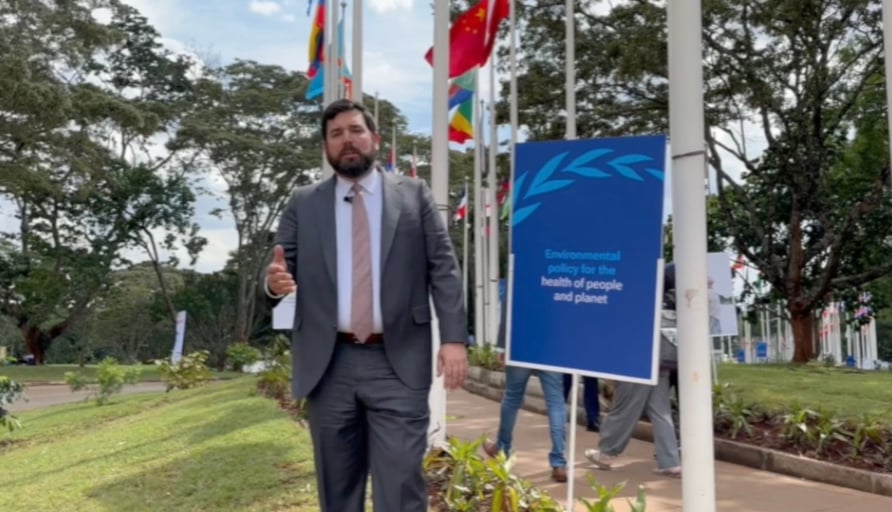
Click here or on the image above to hear Nick Gardner explain why it is important for USDEC to be in Kenya at UNEA-6.
Side event on sustainable dairy ecosystems
Harden spoke at a panel discussion on sustainable dairy ecosystems organized by the International Dairy Federation (IDF) and supported by USDEC. During her remarks, she highlighted dairy’s relationship to one of the key themes that surfaced during the Assembly: soil health. She emphasized how U.S. dairy is maintaining and enhancing biodiversity on dairy farms through investments in soil health and sustainable feed practices.
Farmers rely on healthy soil to sustain their operations and livelihoods, Harden pointed out. “Their feed comes from the soil. It is their working factory. They care very much [about] what goes into the soil and, just as importantly, what comes out. And how to protect that soil.”
Soil health and its impact on biodiversity are hot topics for the UN Environment Programme. These are also areas where USDEC can contribute valuable insights on U.S. farmer-funded investments that support soil health, productivity and profitability. Soil health provides a strategic opportunity to correct misperceptions about U.S. dairy’s commitment to sustainable production and the environment that exist in some circles.
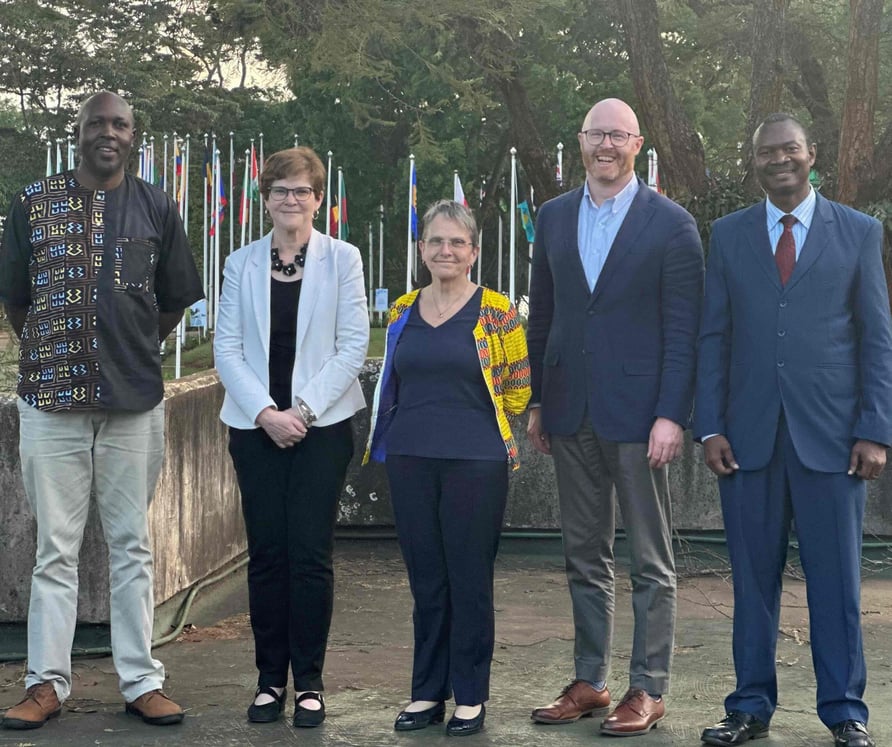
Panelists at the IDF session, “Sustainable Dairy Ecosystems: Nutrition security, women’s empowerment, climate-smart agriculture, action on natures and biodiversity enhancement.” Left to right: James Rao, scientist at the International Livestock Research Institute (ILRI); USDEC’s Krysta Harden; Shirley Tarawaii, president of the Global Agenda for Sustainable Livestock; John Tauzel, senior director, Environmental Defense Fund; and John Walker Recha, ILRI Researcher. Lloyd Day, deputy director general of the Inter-American Institute for Cooperation on Agriculture (IICA), and Meenesh Shah, chairman and managing director, National Dairy Development Board of India, also spoke on the panel but are not pictured.
Non-stop engagement
The USDEC group held bilateral meetings with several member states, including Morocco (which held the UNEA-6 presidency), Argentina (a likeminded ally that USDEC works with across the UN) and Ghana (which has been championing a UNEA resolution to develop a study on the nexus between animal welfare, the environment and sustainable development). They also met with the director general for the World Organisation for Animal Health (WOAH) to discuss the upcoming UN High-Level Meeting on Antimicrobial Resistance.
Maximizing time
In conjunction with major events like UNEA-6, USDEC looks for opportunities to maximize the time and investment required to attend. Last week, that included a meeting with U.S. Ambassador to Kenya Meg Whitman to cover pressing topics beyond the UNEP remit.
Harden, Gardner and Sheridan sat down with the Ambassador and her staff, offering perspectives on the challenges and opportunities that exist in Kenya for U.S. dairy suppliers. The group emphasized the role U.S. dairy can have in driving consumption and building capacity in the local dairy market, leading to mutually beneficial growth. They also pointed out the serious market access and tariff barriers that exist for U.S. dairy exports to Kenya, while sharing optimism about potential programing and investments in Kenya that could come through USDA’s Regional Agricultural Promotion Program (RAPP) allocations later this spring.
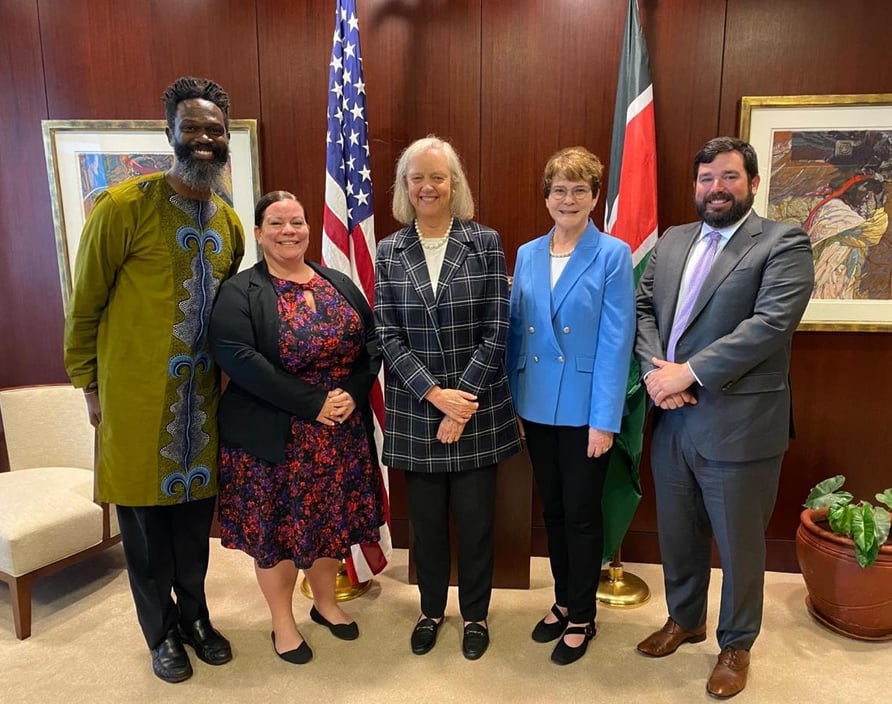
Left to right: Ryan Scott, regional agricultural counselor, USDA, at the U.S. Embassy in Nairobi; Sheridan; U.S. Ambassador to Kenya Meg Whitman; Harden; and Gardner.
Indonesia approves four additional halal certifying bodies
This week, Indonesia's Ministry of Religious Affairs Halal Product Guarantee Organizing Agency (BPJPH) approved four additional U.S. halal certifying bodies (HCBs). Previously, the Islamic Food and Nutrition Council of America (IFANCA) was the only fully recognized U.S. certifier.
The full list of HCBs is now listed on the BPJPH webpage. The U.S.-based HCBs are as follows:
- American Halal Foundation, Tampa, Florida.
- Halal Transactions Inc./Halal Transactions of Omaha, Omaha, Nebraska.
- Islamic Food and Nutrition Council of America, Des Plaines, Illinois.
- Islamic Services of America, Cedar Rapids, Iowa.
- ISWA Halal Certification Department, Silver Springs, Maryland.
If you have any questions, please contact Aimee Pinkerton at apinkerton@usdec.org.
USDEC meets with Indonesian legislators to strengthen the two countries’ collaborative dairy relationship
On March 6, as part of USDEC’s ongoing project to build a closer relationship with Indonesia (a top 10 export destination for U.S. dairy products), USDEC’s Shawna Morris and Jonathan Gardner met with a delegation of Indonesian senators visiting the U.S. Coming on the heels of the newly elected Indonesian president’s campaign pledge to ensure school milk for each child, as well as milk for pregnant mothers, the delegation expressed interest in how the U.S. could help support Indonesia in meeting that goal.
Morris and Gardner outlined the core objectives of the technical collaboration and partnership project that USDEC’s MARA and Trade Policy teams are working to advance with the support of the New Mexico and Wisconsin Agriculture Departments (see Global Dairy eBrief, 2/16/24). The project is focused on providing education on good dairying practices to Indonesia’s small scale dairy farmers to support Indonesia’s efforts to raise the quality of those farms.
As USDEC members continue to grapple with extensive delays in facility registration approvals, the project is also designed to build goodwill with Indonesian government officials that oversee that process.
The following day Gardner joined the delegation for a visit to a Virginia dairy farm so they could see for themselves the high-quality production practices on U.S. dairy farms.
European regulators reach deal on sustainable packaging regulation
On March 4, the European Council and Parliament reached a provisional political agreement on the proposed packaging and packaging waste regulation (PPWR). According to a press release from the European Council, the text maintains most of the sustainable packaging targets that the Commission originally proposed, including a requirement for minimum recycled content in plastic packaging. The legislation is also expected to include a requirement to mandate that all packaging be recyclable, though the design for recycling criteria is expected to follow in implementing legislation.
Although not in the original proposal, the press release indicates that the regulation introduces a restriction on the use of food-contact packaging containing PFAS above certain thresholds.
The provisional agreement will now be submitted to the Council and Parliament for endorsement. If approved, the text will then need to be formally adopted by both institutions before it is published in the Official Journal, which could happen later this year. The regulation will enter into force 20 days after publication and apply 18 months later.
USDEC will continue monitoring for the final regulation and provide additional details to members once the text is available. Please contact Sandra Benson at sbenson@usdec.org with questions.
U.S. ag negotiating team holds the line at MC13
The U.S. ag negotiating team stood up for U.S. dairy and ag priorities at last week’s WTO 13th Ministerial Conference (MC13) in Abu Dhabi. USDEC’s Jaime Castaneda and Tony Rice were in the thick of it throughout the week. As part of the U.S. Coalition for WTO Reform and accredited non-government organization representatives at the ministerial, USDEC advised U.S. government negotiators, met with the WTO Secretariat and like-minded delegations, and persistently voiced U.S. dairy and agriculture priorities.
U.S. ag negotiators successfully blocked an effort led by India to water down WTO disciplines on market price supports for public stockholding programs that have distortionary effects on trade. While an agriculture plan of work remained out of reach, U.S. negotiators will continue to work toward a work program to improve market access and reduce trade-distorting practices.
In addition, a ministerial statement reaffirmed the WTO’s commitment to install “a fully and well-functioning” dispute settlement system by the end of 2024. Ministers instructed officials to accelerate discussions, build on progress already made and work on unresolved issues.
Furthermore, ministers discussed sustainability and recognized the role that the multilateral trading system can play in contributing toward the achievement of the UN 2030 Agenda and its Sustainable Development Goals.
U.S. sets January record for cheese exports
U.S. dairy exports recorded their 12th consecutive year-over-year (YOY) monthly decline in January, as soft global economic growth continued to weigh on consumer purchasing in many key markets. U.S. dairy export volume fell 5% in milk solids equivalent (MSE) terms compared to the previous January. Export value fell 16% to $597.1 million.
At the same time, the new year started with a few encouraging developments as well. Chief among them was cheese. U.S. cheese exports continued their recovery in January, jumping 13% (+4,284 MT) and setting a new record for the month (38,299 MT). It was the third straight month of cheese gains and the largest increase during that streak.
Strong demand from Latin America fueled sales in January. U.S. suppliers increased volume to all major market groups: Exports to Mexico grew 39% (+3,600 MT), volume to Central America soared 53% (+1,845 MT), shipments to South America increased 70% (+910 MT) and cheese to the Caribbean inched up 3% (+59 MT).
There were also bright spots in whey. While overall YOY low-protein whey volume declined for the 12th straight month, two of the three HS Codes that make up the category posted gains. U.S. shipments of dry whey (HS 0404.10.4000) rose for the first time in a year in January and WPC (0404.10.0500) exports gained 4% (only the second increase in the last 12 months). Unfortunately, modified whey (0404.10.0850) fell 17%. Combined, YOY U.S. low-protein whey slipped just under 5% (-1,867 MT). Decreased demand from China remains the biggest drag on volume.
High-protein whey (WPC80+) ran its string of YOY gains to six months with a 25% increase (+1,139 MT) in January. A geographically diverse group of buyers drove the increase, including China, the Netherlands, Indi and Southeast Asia.
For more on the January numbers, including a recap of NFDM/SMP sales and deeper dives into cheese and whey, read the U.S. Dairy Exporter Blog story, “U.S. Dairy Exports off to a slow start in 2024.” In addition, go to the U.S. Exports tab in the USDEC Data Hub and play around with the interactive charts.
USDEC touches base with members, offices in China
A USDEC delegation led by COO Martha Scott Poindexter traveled to China and Taiwan at the end of February to engage with USDEC overseas offices, members and customers, as well as USDA FAS at the U.S. Consulate in Shanghai and the American Institute in Taiwan. It was the latest in a series of listening tours that began in 2022 aimed at aligning and deepening U.S. and overseas office activities to accelerate U.S. export success.
In Shanghai, the group met with representatives from Yum China to discuss the U.S. dairy industry’s ability to help the company meet quickly rising Chinese pizza demand. With over 520,000 MT of new U.S. cheese capacity coming online between 2024 and 2026, the delegation emphasized that U.S. dairy is positioned to easily fill the need for more cheese in China, despite tariffs and geopolitical issues. Poindexter assured Yum that USDEC was working with the U.S. and Chinese governments to promote smooth trade flows and was in the market for the long term.
Meetings with the California Milk Advisory Board (CMAB) in Taiwan focused on recent non-tariff trade barriers. Specifically, new Taiwanese government regulations on zero tolerance of ethylene oxide in imports have been causing some customers to avoid U.S. exports (importers are demanding testing on this pesticide even though pure dairy products are at a negligible risk). The delegation emphasized the need for the U.S. government to help educate regarding WTO standards.
The group also held meetings with the Idaho state government representative in Taiwan, who asked that USDEC consider an ingredient marketing program in the country. Poindexter reported that USDEC will initiate an Ingredients program in Taiwan in the fourth quarter of 2024, pending RAPP funding, and grow the program and activities in 2025 and beyond.
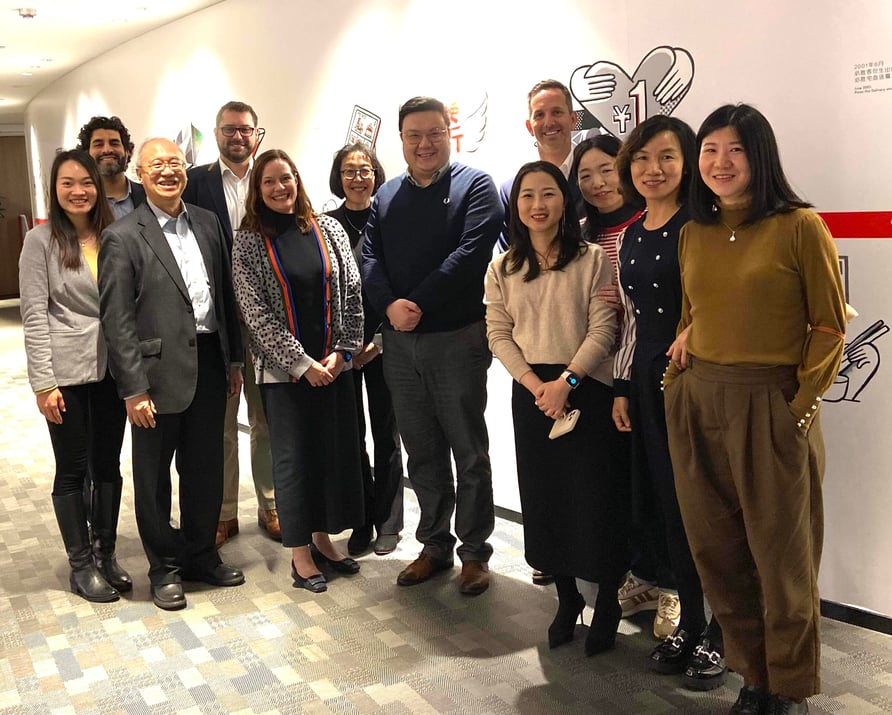
The USDEC delegation, USDEC China office and representatives from Leprino Foods met with Yum China executives to discuss the growing pizza market in China and how U.S. suppliers can help meet pizza cheese demand.
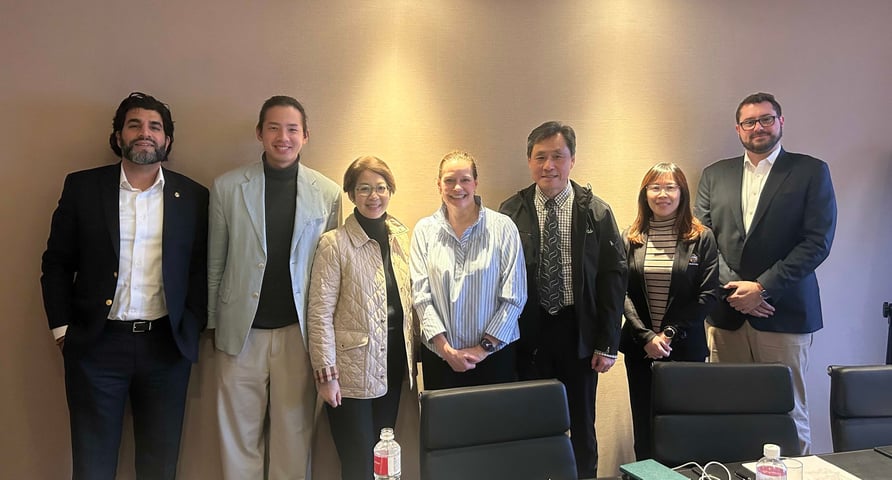
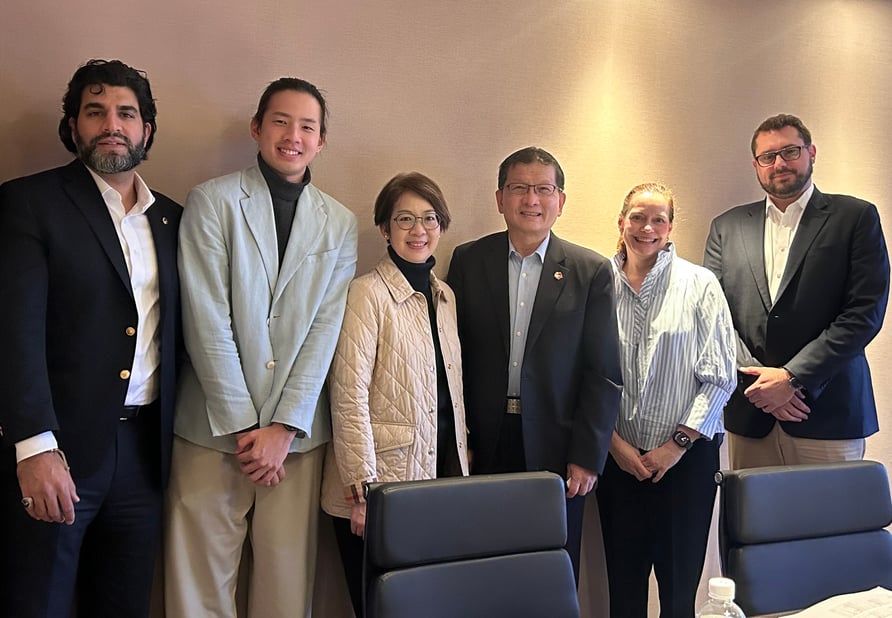
USDEC’s Arlington and Taiwan office staff met with Taiwan-based representatives from California Milk Advisory Board (top) and the Idaho department of agriculture (bottom) to discuss USDEC activities in the region and opportunities to expand U.S. dairy exports.
Nicholson-West speaks at TPM Cold Chain event
For the second straight year, USDEC took to the stage at the TPM, the annual conference for the trans-Pacific and global container shipping and logistics community. Vikki Nicholson-West, USDEC senior vice president, Global Ingredients Marketing, spoke at a panel session titled, “Commodity Spotlight: Macro Trends and Specialized Needs for Reefer Products,” at the new TPM Cold Chain breakout track on March 5.
While logistics have recovered from the supply chain crisis of 2021-2023, U.S. dairy suppliers are still dealing with side effects, including damage to their brand image and reputation. On the plus side, the crisis has sharpened shippers’ capabilities, ushering in system improvements, like better product tracking, improved temperature monitoring and in-market warehousing options. Also enhanced communications between carrier and shipper and greater education of carriers about their dairy cargo are learnings recognized by carriers attending TPM24.
Plenty of challenges still exist to the dairy export cold chain, like reefer availability and the impact of climate change. And while temperature monitoring has improved, there is still a lot of room to further upgrade systems, such as to fully monitor and maintain ideal temperatures over the entire transit journey of a shipment from road to rail to drayage to cargo ship.
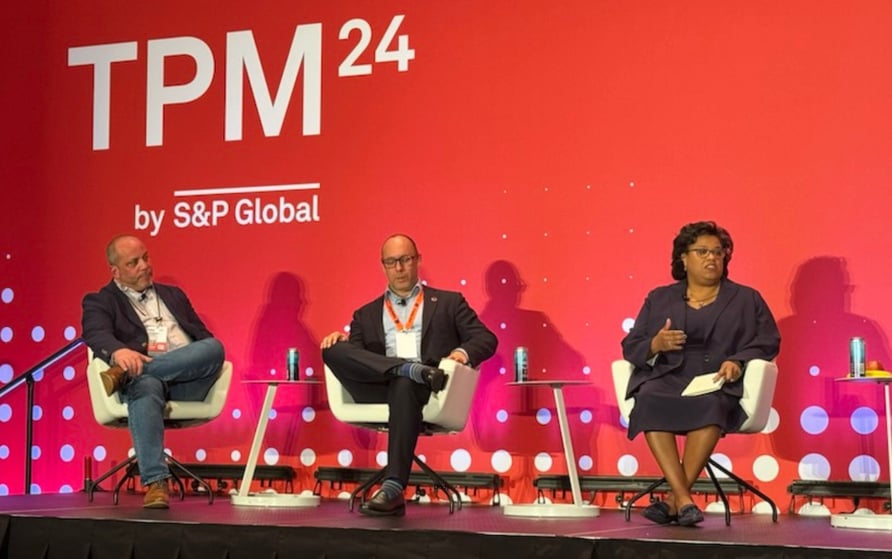
USDEC’s Vikki Nicholson-West (right) on stage at the TPM Cold Chain panel session highlighting the threats, challenges and opportunities facing perishable shippers today.
Harden talks dairy export challenges, potential at High Plains Dairy Conference
USDEC President and CEO Krysta Harden presented a briefing on USDEC, global dairy markets and the U.S. position in them at this week’s High Plains Dairy Conference in Amarillo, Texas. In her talk, “Will exports continue to lead the way?,” she outlined the challenges facing dairy trade growth in 2024, including uncertain Chinese demand and a tentative global economy. Despite the challenges, global dairy trade should see a modest uplift over the next three years, moving back toward the long-term trend after 2023’s decline.
U.S. milk production expansion potential and expectations for stagnant growth from New Zealand and the EU continue to suggest the U.S. is best positioned to take advantage of rising global dairy demand. Harden pointed to several markets where USDEC expects U.S. exports to accelerate over the next few years (2022-2026 vs. 2018-2022), including China, the Middle East/North Africa, Southeast Asia and Mexico.
Events
Enter Now! USDEC assisting with entries to International Cheese and Dairy Awards
The International Cheese and Dairy Awards (ICDA) is a world-renowned dairy competition that takes place each year in the UK. USDEC is again supporting U.S. cheesemaker participation in the awards this year by covering the entry costs for U.S. cow’s milk (including mixed milk) cheeses.
This year’s ICDA takes place June 27 in Stafford, England. No export capabilities are necessary to participate. Registration closes in May, but we encourage you to register early, as USDEC may run out of sponsorship spots, depending on demand.
How to participate
Members interested in participating can begin the entry process by clicking on this link. If you’ve participated in the ICDA before, you can log in to your account and begin registering cheeses, but if you haven’t participated before, you will need to register for a new account.
There are 15 categories that can be entered free of charge. We encourage you to enter as many eligible cheeses as possible. When you register, please select any of the categories beginning with “Best USA Cheese” (class numbers DP455 through DP469). Entries in these categories will be processed with no registration cost to you. These classes are only for cheeses produced with U.S. cow’s milk (including mixed milk). Entry into other classes is also encouraged, however, those will incur the standard entry costs. USDEC will not reimburse entry costs for other classes.
Once you pay for the entries, please reach out to Alex Parker (aparker@usdec.org) and Nuhami Alemu (nalemu@usdec.org) with the number of entries and the categories in which they were entered.
U.S. success in previous contests has enhanced the reputation not only of the winning U.S. cheesemakers but the entire U.S. cheese and dairy industry. For questions, please contact Alex Parker at aparker@usdec.org.
Register for China Webinar—and invite your clients in China
USDEC is kicking off the Year of the Dragon by holding a Global Dairy Market Outlook Webinar for Chinese customers, food and beverage buyers, and end-users. The 90-minute session takes place on March 15 at 10 a.m. China Standard Time (which is U.S. March 14, 10 p.m. EDT) and will explore Chinese market conditions, dairy trade trends in 2023, and the factors that will influence dairy demand and trade in the year ahead.
Three dairy and China experts will present at the webinar:
- Monica Ganley, senior director of Global Trade Analysis, will review 2023 U.S. and global supply/demand outcomes, export expectations for 2024, and what it all means for opportunities for U.S. dairy customers in China and Asia.
- Bing Chen, chief dairy economist from Dairy Association of China (specializing in dairy industry research for the past 16 years), will review domestic Chinese production and demand.
- Daejin Lee, global head of research for UAE-based fertilizer trader FertiStream and an expert on the shipping industry, will share perspectives on key developments on shipping routes, container availability, voyage time and other logistical considerations influencing imports and exports.
The webinar will offer simultaneous Chinese and English audio and most accompanying slides will be bilingual. To register for the event and specify your language preference, please use the links below. We invite you to pass along information on the webinar, including the registration links, to your contacts in the regions. Registered attendees who cannot watch in real time can view it on demand.
English version of webinar.
Chinese version of webinar.
Port expert Arias to speak at USDEC Annual Membership Meeting
As the supply chain crisis showed all dairy suppliers, healthy, modern, well-functioning ports are critical to U.S. export competitiveness, and the Port of Houston is one of the nation’s largest (THE largest when measured by tonnage).
Ricardo Arias, trade development manager at the Port of Houston, will present at this year’s USDEC Annual Membership Meeting in Houston from April 15-17. Arias will share insights and features from the Port of Houston, guiding members through the nuances of the terminals, the port’s capabilities for handling perishables and other insights in a session titled, “The Transformative Power of Ports on Global Trade.”
You won’t want to miss it. And you won‘t want to miss the deadline to reserve a hotel room at the discount rate either. Please click here by March 22 to get to the Omni Houston Hotel reservation page and reserve a room at the special USDEC rate. If you have issues booking a room, please contact Louise Kamali at lkamali@usdec.org.
For information on the full slate of activities on tap at the Membership meeting, download a preliminary agenda here.
Market Summary
GDT falls for first time since November
The Global Dairy Trade (GDT) Price Index dropped 2.3% at the March 5 auction. It was the first setback since early November 2023 and the biggest drop since August last year. The drop was expected—NZX SGX futures markets pointed to milk powder and butterfat declines heading into this week and they were largely correct.
WMP dropped 2.8% to US$3,286/MT; SMP fell 5.2% to US$2,640/MT; and butter slipped 1% to US$6,461/MT. AMF was the only product of the four to avoid its projected decline, rising 1.4% to US$6,637/MT.
The SMP decrease dropped its price back into the $2,600-$2,700/MT range—a band in which it’s settled in seven of the last 10 auctions. WMP, while down two auctions in a row, remained at its highest level in more than a year.
While New Zealand output fell in January and early indications suggest February could be more of the same, lackluster demand is currently the bigger drag on price. Renewed Southeast Asian GDT demand at the end of 2023 has since moderated and a surge in Middle Eastern GDT purchasing ahead of this year’s Ramadan has eased with the holy month set to begin Sunday.
North Asia (China) led all buyers again at this week’s auction, but its SMP, WMP, butter and cheddar volumes fell short of both the previous auction and the same auction last year.
Markret Access and Regulatory Affairs
USDEC makes 56 Export Guide document updates in February
The MARA team also updated or revised 56 documents in the USDEC Export Guide last month. Here are some highlights:
Volume 1: Tariffs and Classification
- China: Noted decreased effective tariff rates for 1901.90.0010 (infant formula for special medical purposes) from 30% to 25%
- Malaysia: Added excise duty of 0.47 MYR per 100g sugar for premixed preparations of certain chocolate products and food preparations of HS 1806.90 and 1901.90, and added increased sugar excise duty from 0.40 to 0.50 MYR per liter for non-alcoholic beverages of HS 2202.
- Vietnam: Changed several milk powder classifications, and updated tax rates for most food-grade products, which were temporarily decreased from 10% to 8% through June 30.
Volume 2: Import Requirements
- EU: Updated Antimicrobial Requirements section to acknowledge the EU’s publication of certificates containing antimicrobial attestations and expected enforcement dates.
- Ukraine: Added updates throughout the document, including a new registration process for specialty foods and limited entry points due to the Russia-Ukraine conflict.
Volume 3: Labeling and Product Standards
- Colombia: Added packaging requirements.
- Japan: Revised packaging requirements.
- Thailand: Revised nutrition labeling regulations.
Every month, USDEC’s Market Access team emails a list of guide updates to interested members. If there is anyone at your company who should be included on the distribution list for that email in the future, please contact Jessica Smith at jsmith@usdec.org.
Company News
Emmi Group posts positive 2023 results
In its FY 2023 annual results, the Emmi Group reported revenue for FY23 up 0.3% from the previous year and adjusted net profit growth of 9.3% from 2022 (adjusted for the one-time loss on the divestment of Gläserne Molkerei and the profit from the sale of the minority interest in Ambrosi). The company credited its positive results to its consistent focus on strategic markets and attractive niches, including chilled premium desserts in the U.S. and Italy as well as in “important growth markets such as Chile and Mexico.” In 2024, the Emmi Group expects the general economic conditions to remain challenging and subdued economic growth in many market relevant to the company. As a result, the company expects organic sales growth of 1% to 2% and a net profit margin of 5.0% to 5.5%. (Company reports)
Mergers, acquisitions and joint ventures
In a move designed to enhance the dairy cooperative’s portfolio of products and geographical reach, Ireland’s Lakeland Dairies completed its acquisition of Belgium-based butterfat business De Brandt Dairy International NV. … U.K.-based Butlers Farmhouse Cheeses acquired Hampshire Cheese. The deal, which will add Hampshire’s continental-style soft cheeses Tunworth and Winslade to the Butlers portfolio, reportedly makes Butlers the largest independent soft cheesemaker in the U.K. (Company report, 3/1/24; FoodBev Media, 3/6/24)
Company Briefs
Saizeriya, an Italian restaurant chain from Japan, invested US$30 million in its Guangzhou subsidiary to build a new plant that will produce sauce, pasta and pizza. The new facility, which is expected to begin operations in January 2026, will reportedly help reduce production costs, stabilize supply and increase capacity as Saizeriya looks to open more outlets in Guangzhou. … Irish co-op Lakeland Diaries received local government permission to proceed with its plans for an extension to its dairy processing facility in County Cavan. The single-story extension is part of a company effort to enhance operational efficiencies and will include storage, packaging and dispatch areas, as well as a corridor linking it to the existing facility. (USDEC China Office; Agriland, 2/27/24)
In Case You Missed It...
U.S. Dairy Exporter Blog
Market analysis, research and news subscribe hereUSDEC Twitter feed
Follow us here.