HIGHLIGHTS: March 21, 2025
• USDEC in Central America
• USDEC signs MOU with Guatemala’s ASODEL
• Egypt excludes dairy from halal mandate
• Ag groups support congressional resolution on agricultural trade
• Feeding the Economy report emphasizes value of U.S. agriculture
• Idaho students visit U.S. CDE
• Member opportunity! USDA ag mission to Dominican Republic
• USDEC 2025 activity list
• Market Summary: GDT flat
• Adjusted NZ milk production rises in February
• OECD lowers economic growth forecasts
• China touts consumption plan
• India goes back to the trade bargaining table with EU, NZ
• Hilmar cuts ribbon on Kansas plant
• Fonterra IPO projections
• Baladna turns focus to high-protein dairy
• Company news: Mondelēz, Bega, Butlers Farmhouse Cheeses, New Culture
Featured
Farmer mission to Guatemala begins, along with cheese supplier mission to Central America
U.S. dairy farmers, U.S. suppliers and USDEC staff are in Central America right now on a farmer mission to Guatemala and cheese supplier mission across the region. The farmer mission concludes today, and the supplier mission extends into next week.
The first full day of the farmer trip kicked off with presentations on the Guatemalan market by Marcela Rondon, regional agricultural counselor for Guatemala, El Salvador and Belize, USDA Foreign Agricultural Service (FAS); Wendy Mena, investment promotion manager at Invest Guatemala; and USDEC Mexico and Central America staff. Retail tours provided additional insights on U.S. dairy currently available in Guatemala and opportunities to fill gaps or build on regional preferences.
Participants also met with U.S. Ambassador to Guatemala Tobin Bradley. Bradley highlighted how his team is working with the Guatemalan government and the country’s president, Bernardo Arévalo, to improve infrastructure, including ports and railways. Bradley said President Arévalo is committed to reducing corruption and restoring the optimism of Guatemalans.
USDEC President and CEO Krysta Harden emphasized USDEC’s desire for strong working relationships with the domestic Guatemalan dairy industry and asked the ambassador’s opinion of what messages the delegation should convey when meeting with them. He suggested recognizing the work they are doing with biosecurity (controlling the spread of New World screwworm) and building awareness around the illicit cattle trade. He also stressed that they would respond to the concept of working together to grow dairy consumption to improve the nation’s collective health and nutrition.
Ambassador Bradley ended with the message that the Embassy is working hard on behalf of U.S. dairy, agriculture and business in general despite ongoing political rhetoric.
On Day 2, the cheese supplier mission and farmer mission converged with a cheese trade seminar highlighting the U.S. as a supply source for the region. For more on that and other news from the Guatemala activities, keep an eye out for upcoming issues of Global Dairy eBrief.
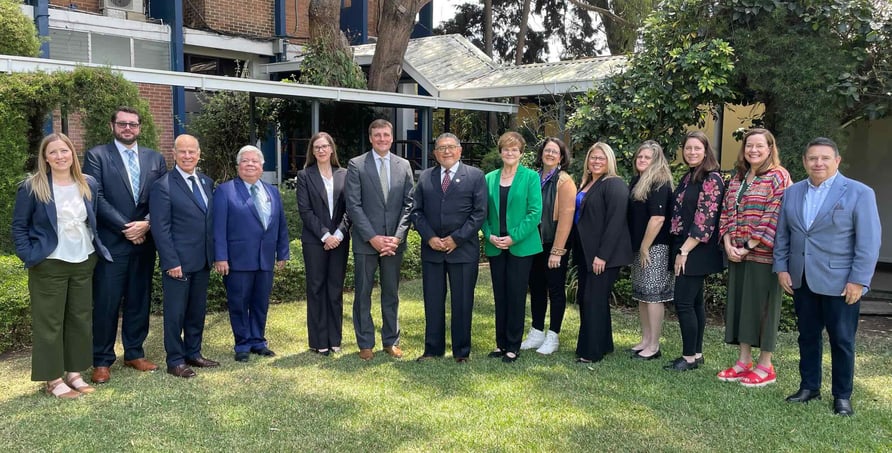
During meetings with Guatemala's Minister of Agriculture, Maynor Estrada (center), the USDEC delegation discussed collaboration on international forums like the UN Food and Agriculture Organization and Codex, as well as working to reestablish dairy in school meal programs.
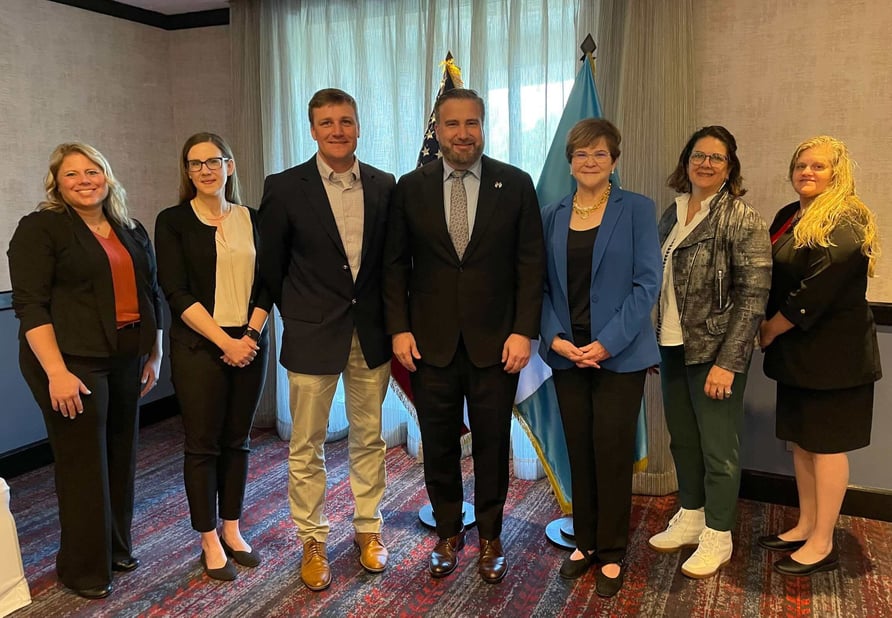
U.S. Ambassador to Guatemala Tobin Bradley (center) flanked by USDEC’s Krysta Harden and the U.S. dairy farmer delegation.
.jpeg?upscale=true&width=892&upscale=true&name=Guat%20retail%20AP%20GK%20(1).jpeg)
Gail Klinkner (WI) and Alex Peterson (MO) get a feel for the types of U.S. and other cheeses available in Guatemala during a retail tour.
USDEC signs MOU with Guatemala’s ASODEL
USDEC and NMPF signed a Memorandums of Understanding (MOU) with Guatemala’s Association for Dairy Development (ASODEL) during this week’s farmer mission to Central America. The MOU is the latest in a line of cooperative agreements inked with global dairy groups to support collaboration and dairy-friendly policies in international forums.
The deal aims to enhance cooperation and knowledge exchange on matters of mutual interest and carry out actions in both markets in defense of milk and dairy products. Both groups stand in favor of trade facilitation and support promoting dairy nutrition and consumption for the benefit of consumer health.
The MOU lays out 11 “points of agreement” to guide the collaborative actions, including promoting the development of science-based international standards and guidelines that support the competitive functioning of global markets and international trade of agricultural products; defending common terms for foods and beverages; and supporting the fundamental role of livestock, animal proteins, and dairy products, specifically in advancing sustainable development and more sustainable food systems.
Guatemala is an important, expanding market for the United States, with significant opportunity to grow still-low per capita dairy consumption.
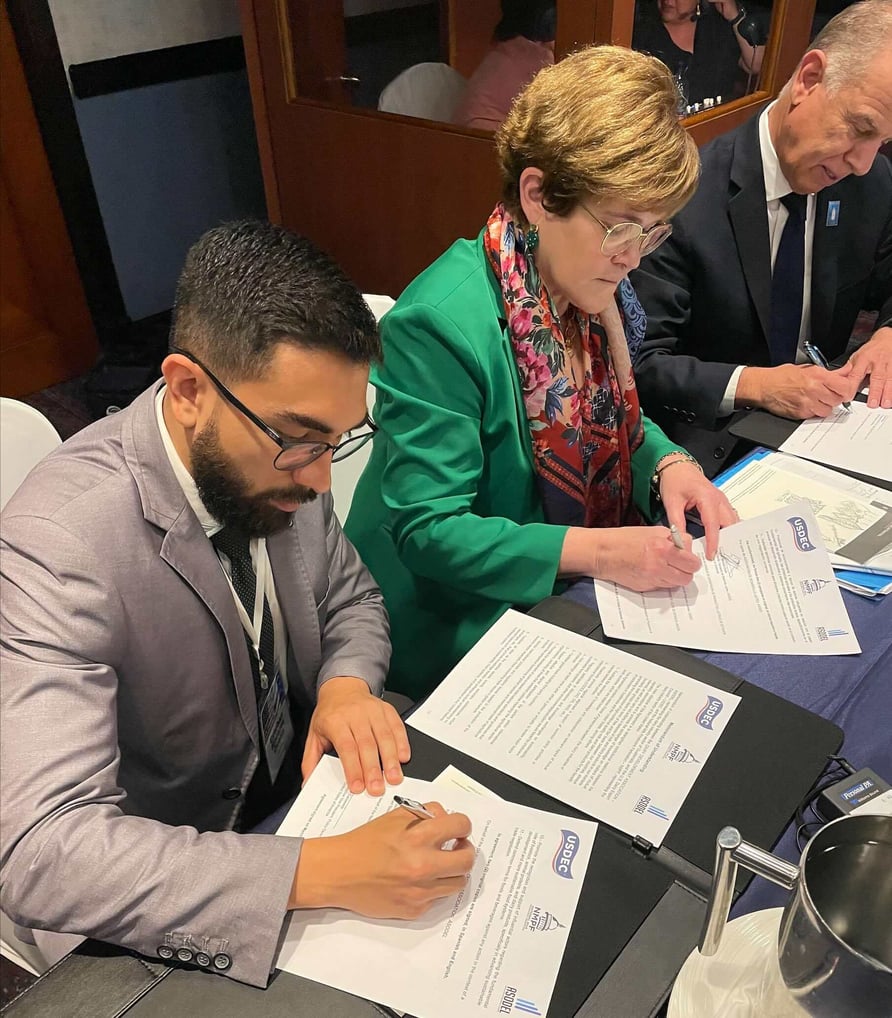
ASODEL President Esteban Morales and USDEC’s Krysta Harden and Jaime Castaneda (signing on behalf of NMPF) endorse the MOU between the dairy sectors of Guatemala and the United States.
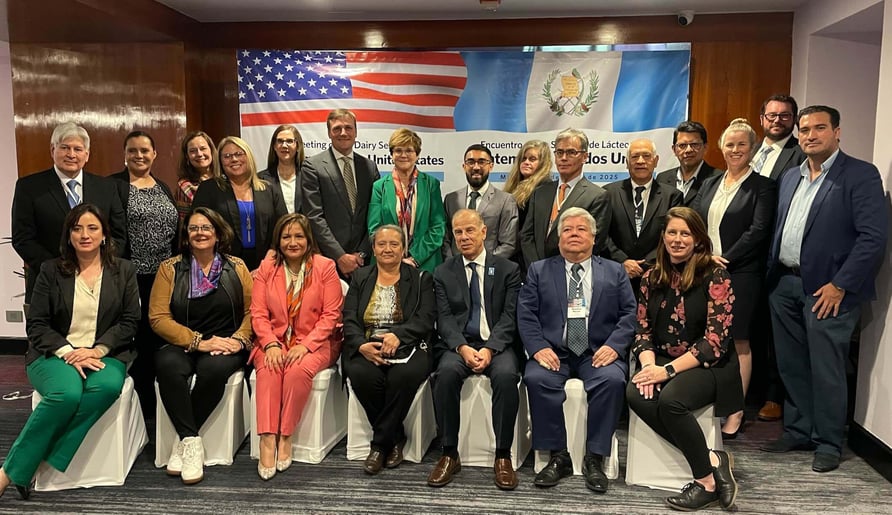
Leaders of ASODEL, USDEC staff and U.S. dairy farmers pause for a group photo after the MOU signing ceremony in Guatemala City.
Egypt excludes dairy from mandatory halal regulation
Egypt amended its pending halal regulation to exclude imported milk and dairy products from the list of product categories requiring mandatory halal certification. Once the regulation enters into force (the current pause in implementation runs through the end of 2025), U.S.-origin milk and dairy products will be allowed to continue being shipped to Egypt without halal certification. However, for suppliers seeking halal certification, Egypt continues to recognize ISEG as the only approved certifying body.
USDEC continues to actively work with the U.S. government on halal issues in Egypt, particularly allowing a single halal certifier. The Market Access and Regulatory Affairs team will provide updates as soon as confirmed official information becomes available. In the meantime, if you have any questions, please contact Bryan Jacoby at bjacoby@usdec.org.
USDEC supports congressional resolution on ag trade
A coalition of U.S. agriculture groups, including USDEC and NMPF, endorsed a March 19 House resolution supporting food and agricultural trade. The resolution expresses the urgent need for Congress and the administration to work together to pursue effective food and agricultural trade policies.
After citing numbers from the “Feeding the Economy” report (see story below) highlighting the importance of agriculture to U.S. economic health, the resolution goes on to point out the rising U.S. ag trade deficit and the unjustified, nonscience-based trade barriers and trade-restrictive tariffs U.S. agriculture faces in key markets around the world.
The resolution lays out six measures aimed at addressing the problem:
- A renewed commitment to secure new and expanded market access and maintain global competitiveness for the U.S. food and agriculture industries.
- Strong support for domestic trade promotion programs.
- Comprehensive trade agreements with key trading partners that improve market access by lowering tariffs and removing non-tariff trade barriers.
- Improved enforcement of existing trade agreements.
- Elimination of longstanding unwarranted nontariff trade barriers through effective and efficient dispute settlement processes.
- Pursuit of a global trading system in food and agriculture based on sound science through bilateral and regional agreements as well as the WTO and other international bodies.
Feeding the Economy report reiterates agriculture’s sizable impact on the U.S. economy
The 2025 “Feeding the Economy” report found that the U.S. food and agriculture industries’ total contribution to the U.S. economy in 2024 topped $9.5 trillion or just under 19% of the country’s total economic output.
Released on National Ag Day by 36 food and agriculture groups (including USDEC and NMPF), the report reinforces to policymakers and consumers the major role agriculture plays in U.S. economic prosperity.
The agriculture industry has shown significant growth since the pandemic, increasing its economic output by close to 25% and demonstrating the industry’s resilience and innovation amidst global supply chain challenges. The United States exported nearly $183 billion in food and agriculture products last year, testifying to how critical foreign markets are to the strength and growth of the industry.
“The Feeding the Economy report underscores the essential role American dairy producers and processors play in sustaining global food security and economic vitality,” said USDEC President and CEO Krysta Harden. “U.S. dairy exports not only nourish communities worldwide but also drive economic growth, supporting millions of jobs across the supply chain. We look forward to building upon this important base and growing opportunities for generations of American workers to come.”
Agriculture was responsible for more than 47 million U.S. jobs last year and $2.8 trillion in wages. Despite such notable contributions to the U.S. economy, certain emerging trends represent an industry under pressure. Direct and indirect industry wages have grown year-over-year but have failed to keep pace with inflation, and the number of agriculture-related jobs fell from 2023 to 2024 and is down nearly 30,000 since 2020.
For more on the study, go to the Feeding the Economy home page, where you can look up agriculture’s impact by state and congressional district by scrolling down to the interactive U.S. map.
Idaho ag students visit U.S. CDE
Highlighting its role as a knowledge hub, the U.S. Center for Dairy Excellence (U.S. CDE) hosted a group of four students from the University of Idaho's College of Agriculture & Life Sciences for a day of learning. The students, led by Bob Haggerty, the university’s director of International Programs, ranged from agricultural management undergraduates to dietetics graduates.
The visit, structured as an interactive learning experience, aimed to provide students with insights into how U.S. dairy products are integrated into Southeast Asian diets and how the various USDEC outreach activities help to build demand and market access to the region.
The students were particularly engaged in the hands-on kitchen demonstration, where they explored U.S. dairy ingredients and created the U.S. CDE signature “Tangy Yuzu Whey Protina Colada” drink made with U.S. WPI. They also had the chance to try innovative, Southeast Asia-friendly U.S. CDE prototypes like the Protein Pandan Coconut Granola Bars and Protein Lychee Meringue Gems. A sensory evaluation session helped them understand how USDEC’s Southeast Asia team assesses consumer preferences for U.S. dairy-based innovations.
The visit concluded with insights from Siew Guan Lee, a registered dietitian and the university’s extension educator, who shared her experience at the recent U.S. Dairy Ingredient Innovation Workshop (see Global Dairy eBrief, 2/28/25), where she offered a nutritionist’s perspective on dairy’s role in supporting better-for-you bakery and sweet snacks. Lee is currently on sabbatical in Singapore and collaborating with the U.S. CDE team.
The visit allowed students to connect their academic knowledge with real-world practices in the global dairy sector.

University of Idaho’s Bob Haggerty (left) and Siew Guan Lee (second left) with the four U of I students in the U.S. CDE’s demo kitchen.

USDEC Southeast Asia Food Technologist Reuben Ang (left) talks two University of Idaho students through a hands-on protein-boosted beverage formulation.
Events
USDA accepting applications for Dominican Republic agribusiness trade mission
USDA’s Foreign Agricultural Service (FAS) is inviting U.S. ag exporters to participate in a July 13-17 trade mission to the Dominican Republic, the largest economy in the Caribbean and the seventh largest in all of Latin America. Participants will join buyers from the Dominican Republic, Haiti and Jamaica for targeted business-to-business meetings to explore and discuss potential business opportunities in each country.
FAS-sponsored international trade missions aim to connect U.S. agricultural suppliers with prospective customers, giving U.S. companies the opportunity to forge relationships, gather market intelligence and generate sales. In addition to the B2B meetings, the mission includes in-depth market briefings by FAS staff, site visits and networking events. For more information on the trip, including an online application form, click here. The application deadline is Wednesday, April 2.
USDEC 2025 events
For your convenience, USDEC has compiled a chronological list of dairy export-related member events currently slated for 2025. This list is effective as of March 21 and will evolve as new opportunities develop, funding is finalized, or unexpected changes arise.
MARCH
- Central America Supplier Mission, Guatemala, Costa Rica, Panama, March 16-25, 2025
APRIL
- USDEC Annual Membership Meeting, Washington, D.C., April 7-9, 2025
- Ingredients Advisory Group, Washington, D.C., April 9, 2025
- Cheese and Consumer Products Advisory Group, Washington D.C., April 9, 2025
- Food and Hotel Asia Tradeshow, Singapore, April 8-11, 2025
MAY
- Southeast Asia U.S. Dairy Proteins Healthy Active Aging Innovation Workshop, Singapore, May 7-8, 2025
- China Bakery Exhibition, Guangzhou, May 10, 2025
- USDA Agribusiness Trade Mission, Hong Kong, May 12-16, 2025
- China Animal Husbandry Expo (CAHE), Qingdao, May 19-21, 2025
JUNE
- USDA Agribusiness Trade Mission, Peru, June 9-12, 2025
- Seoul Food and Hotel Trade Show, Seoul, June 11-14, 2025
- International Cheese and Dairy Awards, Stafford, England, June 25-26, 2025
JULY
- USDA Agribusiness Trade Mission, Dominican Republic, July 13-16, 2025
- Expo IAlimentos, Colombia, July 30-31, 2025
AUGUST
- Food Ingredients South America, Brazil, Aug. 26-28, 2025
SEPTEMBER
- U.S. Dairy Supply and Innovation Seminar, Thailand, Sept. 15, 2025
- Food Ingredients Asia, Thailand, Sept. 17-19, 2025
- Espacio Food and Service, Chile, Sept. 30-Oct. 2, 2025
OCTOBER
- USDEC Sustainability Seminar, Singapore, Oct. 7-8, 2025
- Food Tech Summit & Expo, Mexico, Oct. 8-9, 2025
- IDF World Dairy Summit, Chile, Oct. 16-25, 2025
- Ingredients Advisory Group Tactical Plan Meeting, Chicago, Oct. 21, 2025
NOVEMBER
- USDA Agribusiness Trade Mission, Mexico, Nov. 3-6, 2025
- Gulfood Manufacturing, Dubai UAE, Nov. 4-6, 2025
- COP30, Brazil, Nov. 10-21, 2025
- World Cheese Awards, Bern, Switzerland, Nov. 13-15, 2025
DECEMBER
- USDA Agribusiness Trade Mission, Cote D’Ivoire, Dec. 8-11, 2025
- 4th Quarter Joint USDEC Meeting of the Cheese and Consumer Products Advisory Committee and the Trade Policy Committee Meeting, Washington, D.C., Dec. 10-11, 2025
Market Summary
GDT holds steady
The Global Dairy Trade (GDT) Price Index didn’t move at the March 18 auction. Mixed category-by-category performance resulted in zero change. All products except SMP and AMF posted gains—but nearly all were modest. The average winning price for flagship WMP inched up 0.2% to US$4,052/MT, helped by reductions to instant WMP allocations prior to the event.
The world can’t seem to get enough butter, as prices hit a GDT record for the second consecutive auction. The average winning butter price increased 1.1% to US$7,667/MT, driven by North Asia (China), Europe and the Middle East.
On the cheese side, cheddar gained for the fifth time in the last six auctions, rising 1.0% to US$4,976/MT. North Asia (China), Europe and the Middle East were the market movers again. Mozzarella recorded the largest increase for the auction, jumping 5.1%. After two-plus months of fairly stable pricing dating back to December, mozzarella is up 13% over the last two events.
North Asia (China) topped all buyers and increased its auction share to 32% (compared to 28% at the previous event). In what may be a first, Europe, which led all SMP buyers and was active in cheddar, butter and AMF, passed Southeast Asia as the No. 2 buyer overall at 22% (vs. 20% at the previous auction). Southeast Asia finished the event with only 20% of volume (compared to 24%-33% since December 2024).
The GDT Price index has held fairly steady for the past three auctions now. With the Northern Hemisphere spring flush around the corner, the volatile trade policy landscape and its potential impact on economic growth, buyers are cautious, particularly with prices at historically elevated levels.
NZ milk production rises in February (after leap day consideration)
After accounting for the extra day in the leap year, year-over-year New Zealand milk production rose 1% in February. The increase came despite a spreading drought in the country. After officially designating Taranaki in drought in February, the government assigned a drought designation to four more North Island regions earlier this month—Northland, Waikato, Horizons, Marlborough-Tasman.
Some dairy farmers are using supplemental feed, drying off cows earlier than usual and expressing growing concerns over potential shortages of winter silage. The conditions may have slowed milk production growth, but producers were still matching previous-year output through February (after accounting for the additional day of production in 2024). Milk solids production in February grew 1.5% (after leap year adjustments). (Dairy Companies of New Zealand; Radio New Zealand, 3/18/25)
OECD lowers economic growth projections
The Organization for Economic Cooperation and Development (OECD) lowered its economic growth forecasts for 2025 and 2026 citing emerging “signs of weakness.” Specifically, the group pointed to higher trade barriers in several G20 economies, resurgent inflation, and increased geopolitical and policy uncertainty weighing on investment and household spending. OECD’s December projection for global GDP growth fell from 3.3% in 2025 and 2026 to 3.1% this year and 3.0%. The downward adjustments were even sharper for Mexico, Canada and the United States. (OECD; New York Times, 3/17/25)
China fills in some details on consumption growth plans
On Sunday, China’s State Council unveiled a wide-ranging “special action plan” to boost domestic consumption, including establishing a childcare subsidy scheme, increasing urban and rural incomes, guaranteeing workers’ rights and vacation days, encouraging paid annual leave and short holidays, stabilizing the stock market, and boosting tourism. The announcement follows heightened emphasis by Chinese Premier Li Qiang on lifting domestic consumption earlier this month at the annual meeting of China’s parliament (see Global Dairy eBrief, 3/14/25). The State Council plan included more detail than previous aspirational statements on consumption, but it was still more like a to-do list rather than a roadmap and it failed to outline the resources needed to follow through on such ambitious plans.
China is looking to reduce reliance on exports for economic growth. While Chinese exports rose less than expected in January and February, retail sales (even without new consumption-oriented assistance) strengthened over the first two months—although economists largely attributed the gains to holiday buying for the Lunar New Year. (Reuters, 3/17/25, 3/16/25)
India goes back to bargaining table
India and New Zealand restarted negotiations on a “Comprehensive Free Trade Agreement” after a nine-year layoff. Talks broke down in 2016 in part over India’s refusal to loosen dairy import barriers. New Zealand’s dairy sector was cheered that the two sides announced the current talks would be “comprehensive,” interpreting that as “inclusive of dairy products.” But India has a long history of shielding its dairy industry from outside competition. The first round of talks is scheduled for April.
New Zealand isn't the only country to think this time might be different for India when it comes to dairy in trade talks. In February, the EU and India agreed to conclude a trade deal by the end of the year. The two sides resumed negotiating in 2021 after an eight-year layoff. While both sides have signaled they are more motivated to find common ground because of uncertainty over U.S. trade policy, a comprehensive deal remains a heavy lift. (Farmers Weekly, 3/17/25; BBC News, 3/17/25; Reuters, 2/28/25)
Company News
Hilmar opens new Dodge City facility
California-based Hilmar Cheese cut the ribbon on its new $600-million production facility in Dodge City, Kansas this week. The facility makes American-style cheese in commercial 40-pound blocks, which are then sold wholesale to customers and used in a variety of foods. It also produces a wide range of innovative proteins to meet the needs of customers worldwide. The new site employs nearly 250 people. (Company reports)
Sources estimate Fonterra’s consumer IPO could raise US$2 billion
Bankers for New Zealand dairy cooperative Fonterra are scheduled to present to Sydney fund managers next week about the ASX listing of Mainland Group, the company’s consumer business (see Global Dairy eBrief, 2/21/25). Sources reported this week that the consumer business, which includes the Western Star butter and Mainland cheese brands, could be valued at up to NZ$4 billion (about US$2.3 billion) and that the potential IPO might raise between NZ$1.5-$2 billion (about US$873 million-$1.2 billion). Rene Dedoncker, who is slated to become the consumer business’s CEO, will lead the IPO meeting, which the company is calling a “non-deal roadshow.” (The Australian Financial Review, 3/12/25)
Baladna shifts focus to high-protein products, Algeria in 2025
Qatar-based dairy company Baladna said it is shifting its growth strategy toward high-protein dairy products and significant collaboration with Algeria following the collapse of a joint venture in Malaysia (see Global Dairy eBrief, 12/20/24). The shift was discussed as the company announced its full-year financial results for 2024, revealing a record-high revenue of US$316 million, an 8% increase from the previous year. Net profit also jumped 69% to US$51 million.
According to the company, Baladna holds a 96% share in fresh milk and nearly 93% in UHT milk in its home market. With this solid foundation, the firm said it is exploring new avenues to sustain that growth. During a recent investors’ meeting, Baladna CFO Saifullah Khan emphasized the company’s focus on innovation, noting that “On the consumer strategy front, we have strong interest in the high-protein milk and yoghurt segments, and have already launched new innovations into this market where we see a lot of potential.” The company added 39 new products in 2024, including new Greek yogurt flavors, an enhanced cheese range, and a revitalized Awafi product line.
Khan also highlighted Baladna’s partnership with the Algerian National Investment Fund to establish a large vertically integrated dairy farm (see Global Dairy eBrief, 9/13/24) as well as other agreements to strengthen its presence in Algeria—including a Memorandum of Understanding with the Algerian government to explore infant milk production. (USDEC Middle East/North Africa Office; Dairy Business Africa, 3/11/2025)
Mondelēz and Lotus Bakeries expand partnership to grow Biscoff ice cream
Chicago-based Mondelēz International and Belgium-based Biscoff maker Lotus Bakeries announced an expanded partnership to produce Biscoff-branded frozen novelties. The companies are working with England-based Froneri, which manufactures ice cream under license for Mondelēz and other companies, to produce the products in a move designed to expand Biscoff’s global presence. Froneri will produce, market and sell Biscoff ice cream in several European countries starting in 2026 before gradually expanding into other areas. (Food Dive, 3/14/25)
Bega Group reports 1H 2025 results
In its half-year 2025 results, Australian food and beverage giant Bega Group, which includes the Bega Cheese brand, reported revenues hit $1.8 billion (about US$1.1 billion) over the six-month period, an increase of 3% compared to the same time last year. The company cited the recovery of the Bulk segment as a key factor in the gain. Normalized EBITDA jumped 44% from the previous year, and profitability in the Branded segment increased 8%, an increase the company said, “reflects the success of cost-savings initiatives (including supply footprint rationalization) as well as focus on high-value categories.” Looking ahead, the company reaffirmed its target of a normalized EBITDA of $190 to $200 million (about US$121 million to $127 million) for the full year. (Company reports)
Mergers, acquisitions and joint ventures
Indian agri-food group Godrej Agrovet struck a deal to become the sole owner of local dairy business Creamline Dairy Products. The company, which first invested in Creamline in 2005 and already owns nearly 52%, will pay Rs9.3 billion (about US$107 million) for the remaining shares. … In a move to expand its presence in the premium yogurt category, UK-based organic food company Yeo Valley Production acquired Epicurean Dairy (UK), the owner of The Collective yogurt brand. (Just Food, 3/13/25, 3/12/25)
Company briefs
After a devastating fire destroyed its previous facilities in 2023, UK-based Butlers Farmhouse Cheeses announced it has received permission from the local government to construct a state-of-the-art cheesemaking campus on its Inglewhite farm. The company expects to complete the facility by the end of 2025. It will feature a maturation space tailored to the unique requirements of farmhouse cheese production. … California-based New Culture announced it has received a $5 million investment from pizza chefs and restaurant operators for its plant-based mozzarella alternative, which is formulated with a casein derived from precision fermentation. … Lifeway Foods shareholder Edward Smolyansky launched an official campaign to replace the board of directors of the Illinois-based kefir and probiotic products manufacturer at its next annual meeting. In a statement, Edward, the brother of Lifeway CEO Julie Smolyansky, said “The Board's failure to maximize shareholder value while enriching the CEO warrants a complete and immediate overhaul.” He proposed a “new slate of independent directors” that includes himself and his mother, Ludmilla. (Company reports)
In Case You Missed It...
U.S. Dairy Exporter Blog
Market analysis, research and news subscribe hereUSDEC Twitter feed
Follow us here.
